Apollo and Daphne: multi-angled view
The curious sculpture Apollo and Daphne , with its angled lines and voluptuous contours, is an excellent example of Bernini’s ability to incorporate movement and depth into his works. I have always been interested in seeing how various artists dealt with the “problem” of translating a three-dimensional image onto a flat sheet of paper. It was always interesting to me that, even in the Classical period, sculptures, too, seemed restricted in their design so as to be viewed from a single angle. Bernini designed extremely emotive works that could almost be construed as entirely new pieces from each different perspective. He managed to create a rich source of visual material with which to work, at least when it came to my attempts at translating his works onto pencil and paper.
With Apollo and Daphne, contortion and minute attention to detail—especially when incorporating new information with each angle—makes the image particularly vivid and dynamic. As Apollo leans forward to grasp the nymph’s waist, she begins to turn into a tree, escaping his grasp even as he holds her in his arms. The work is not too original in its subject matter, other artists in the Renaissance and Baroque had shown special attention to the Greek myths. The gods of ancient Greek history represented the idealized human form. Additionally, the myths were a vehicle for highlighting human emotion, capitalizing on the pathos of the Greek tragedy. Bernini’s figures are unique in that they blur the line between marble and flesh, static representation and fluid movement. The lack of straight lines and the rich detail in the varying planes of viewing—front, back, and side-angles—contribute to this sense of movement, and so when the nymph lunges forward and away from her pursuer, it almost seems as if she is leaping through the air. The sculpture becomes a scene rather than a mere carving of two figures, which in turn shifts the focus from a strict viewer/subject divide into a dynamic unveiling of the interaction between the figures themselves.
I realize the first image is not a drawing, but it shows Bernini in his best medium, I believe. The first self-portrait posted above was created in 1624 when Bernini was still under the patronage of pope Urban VIII. This is a humble work compared to other projects he did during this period, such as the massive gilt-bronze baldachin he designed for the tomb of St. Peter in St. Peter’s Basilica. At the same time, the sketch has its own unique appeal in its use of line and shading. One of the most interesting characteristics of this work is its use of variations in line thickness and darkness to represent the reflection of light off of a hairline. As a sketch, it was probably not intended to be viewed as a separate piece but as a starting point for a full painting. The edges of the neckline and even the right jaw-line is not strictly defined, instead, deep strokes create the illusion of depth by shrouding that part of the face in shadow. Adding to what I call an “unfinished feel” is mingling of smudging techniques and a subtle hatching technique. The lines in areas of heavy shadowing like the top of the head and the area below the chin are still somewhat discernable, but because they are all in one uniform direction (like the hair strands) or in many different directions (such as the base of the neck), the viewer interprets them as one unit.
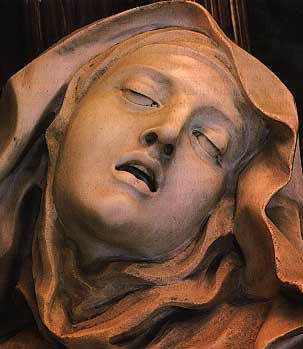
One advantage of being a sculptor as well as a sketch artist and painter is that it allows one to test out certain visual compositions before committing them to marble (or guilt-bronze, as the case may be). Bernini often would sketch out his sculptures prior to beginning the sculpting process. These sketches can range from very detailed (for example, his Study for the figure of “Daniel” in the Chigi Chapel, S. Maria del Popolo) to very loose and cartoon-like (such as his “Studies for the Statue of Truth”), the latter possibly functioning as a means of seeing how the entire work would look as a unit or jotting down ideas for future compositions. Bernini’s versatility with sketching and drawing is evident when one compares the highly realistic self-portrait to his more abstract, simple sketch of his Ecstasy of St. Teresa. In the second one, created with chalk on paper, the lines that denote shadowing are much more visible and there is minimal smudging. Clearly the emphasis with the close-up of St. Teresa is on the angle of her face and the effect of this posture on the coif and the veil of her nun’s habit. Comparing the finished product (top image) to the sketch, one gets an idea of the function of these sketches; they capture the overall impression of the work—testing out the shadow, the silhouettes and overall composition of the sculpture.
A “child prodigy,” Bernini began sculpting at a very early age and has often been associated with the Italian Baroque as one of its most prominent figures. He was the son a sculptor, Pietro Bernini, of lesser renown in Naples. He began his career as a master sculptor very early in life, according to one anecdote (perhaps exaggerated by the none-too-modest artist) he presented a bust of St. John to Pope Paul V. The Pope did not believe that the ten-year-old miniature master was indeed the artist behind the likeness, and so decided to test him by having him create a sketch right in front of him. Apparently, the sketch must have been of great quality, seeing as he began working under the patronage of the Pope from that moment on.
But Bernini’s great works were not created in a vacuum, indeed his formidable years took place in a period of great artistic flourishing throughout Italy, called the High Renaissance. His primary influences were from antique Greek and Roman marbles (which explains both the style and subject matter of the Apollo and Daphne piece, with its poignant pose reminiscent of the Greek Hellenistic period), as well as contemporary artists like Michelangelo and other High Renaissance painters. He had many patrons over the course of his life and was especially favored by the Church. His works under the patronage of Cardinal Scipione Borghese include the previously mentioned Apollo and Daphne, and his famous David (1623-24).
At the height of his artistic renown, Bernini was commissioned large projects by the Church, including the larger-than life statue of St. Longinus in St. Peter’s church, which he sculpted from 1631-38. His work in portraiture was also developed greatly during this period of time, and his repertoire included a series of commissioned portrait busts of Pope Urban VIII. His fantastic, highly elaborate fountains were commissioned under the patronage of Pope Innocent and Alexander VII, this includes the Fountain of Four Rivers which is located in the Piazza Navona. I remember staring at my art history book, analyzing every intricate detail, the painstaking efforts taken to get the composition just right. In the end, there is a kind of triangular build, but there is so much movement in the individual figures that the underlying order of the structure is very subtle.
Later in life, he concentrated more on architectural works like the massive colonnade in front of St. Peter’s Basilica in Rome. In 1665, he took up an invitation to visit Paris from King Louis XIV himself. He made the mistake, however, of insulting the French court by expressing his preference for Italian art over that of France—a costly mistake since it probably kept him from gaining further commissions from the King. He did, however, make an impressive portrait bust of King Louis XIV before leaving Paris. His final years are probably not given as much publicity as the previously mentioned commissions, but there are a few that are noteworthy. Daniel in the Lion’s Den (1655-61) is part of a two group project created for the Chigi Chapel in Rome. The emotional, dramatic figures are emblematic of the artist’s maturation of style and composition.
After an impressive and prolific career, Bernini died at the age of 81 in Rome in 1680. His works, whether paintings, sculptural groups, portraits or architectural projects, would set the standard for Baroque art throughout Europe for nearly a hundred years.
Bibliography
Images
ARTstor Collections
Flickr.com
Linesandcolors.com
Biographical information
Scribner, Charles. Bernini. New York : H.N. Abrams, Publishers, 1991.
 Like the majority of Raphael's paintings, Study for the Borghese Entombment, 1507, is a study for a later painting. The drawing was done in pen and ink with traces of under-drawing in black chalk. The abundance of diagonal line work truly conveys the weight of Christ's body on the bearers, a perfect example of Raphael's ability to capture movement.
 Cartoon for St. Catherine of Alexandria, 1507, is a drawing done solely in black chalk. I chose this drawing because of the sense of movement captured in the portrait by the use of curves. Historically, this portrait is reminiscent of ancient sculptures of the goddess Venus.
 Study for the left side of the Disputa, 1508, is my favorite drawing out of the three. The material used for the drawing is diverse, including pen and ink with wash over stylus and some white heightening. I particularly like how the figure at the far left has been highlighted in white to emphasize his movement up the staircase, a rather overt case of dynamism in a drawing.