Monday, February 25, 2019

Contemporary Art: An Evolution of Appreciation

From confusion to awe to a developing appreciation, my relationship with contemporary art has evolved over time. My first memories of art were my own contemporary “masterpieces,” abstractions created from glitter glue and finger paint. From a young age, my parents accompanied me on countless museum trips, and I remember never quite understanding what was so exciting about a huge canvas covered in solid red paint, or other contemporary abstractions. But these museum trips created a lifetime appreciation for art that eventually led me to attend a pre-college program at the Cleveland Institute of Art.

The program was accompanied with free access to the Museum of Contemporary Art, or MOCA, which my friends and I happily took advantage of throughout the program. Concealed within the mirrored, geometric building was some of the most peculiar artwork I have ever experienced. I remember sitting in a dark room for at least half an hour, trying to make sense of Lu Yang’s animated work entitled Delusional Mandala. According to the MOCA website, the purpose of Lu Yang’s work was to “... investigate how neuroscience, medical and digital technology, and the Internet are changing society” (“Museum of Contemporary Art Cleveland”). This was my first introduction to the use of art to explore technology’s effects on society, an area I am exploring today. But Lu Yang’s imagery was wild; after staring at a variety of dancing body parts and psychedelic buses, I left feeling at once fascinated and a bit violated. This animation got somewhere deep inside my head, recurring in my memory throughout the next few weeks. Though I went into the exhibit somewhat skeptical, it had an incredible impact on me.

Fast forward about a year and a half to this past winter break, when my family went to visit the Whitney Museum of American Art in New York City. I was weary of being pushed through crowds of tourists, but I entered the Whitney with an open mind, eager to see and learn something new. We first went straight to the special Andy Warhol exhibit. Of course, I was familiar with Warhol’s Campbell’s Soup series, but I did not understand the story of his life beyond the pop art designs most Americans recognize. From this exhibit, I gained insights into Warhol’s ever-morphing identity and opinions, from his sexuality to his political views. I left with a heightened understanding not only of the art, but also the artist behind the work.

More exciting to me than Warhol’s exhibit was the exhibit Programmed: Rules, Codes, and Choreographies in Art, 1965–2018. From the Whitney website, “...Programmed traces how rules and instructions in art have both responded to and been shaped by technologies, resulting in profound changes to our image culture” (“Programmed”). Like Lu Yang’s work I had seen in Cleveland, this was an entire exhibit dedicated to the intersection between art and technology. This was the kind of contemporary art I could relate to. After years of confusion about seemingly forced deep meanings in contemporary art, I could see the meaning in this exhibit. I was particularly drawn to W. Bradford Paley’s Codeprofiles, which visualizes “...how code is read by people, written by programmers, and executed by computers” (“Programmed”). Lines moved across the screen, representing how code is written, read, and implemented. I was entranced. This exhibit spoke to my interests outside of art, expressing the art behind programming and algorithms.

As my family left the museum, we shared our favorite exhibits, finding that we each had different preferences; different works piqued our interest. Now I see that, perhaps, there is contemporary art for everyone. I believe that if you look around, you will find something that speaks to you. You just have to be willing to look long enough to find it.

References

“Museum of Contemporary Art Cleveland.” Home | MOCA Cleveland, 2 June 2017,
www.mocacleveland.org/exhibitions/lu-yang-delusional-mandala.

“Programmed: Rules, Codes, and Choreographies in Art, 1965–2018.” Hopper Drawing | Whitney Museum of American Art, whitney.org/exhibitions/programmed?section=3#exhibition-artworks.

Link to Lu Yang's Delusional Mandala: http://luyang.asia/2016/12/09/luyang-delusioanl-mandala/

Immersion as a form of art to prompt sense of self - Mary

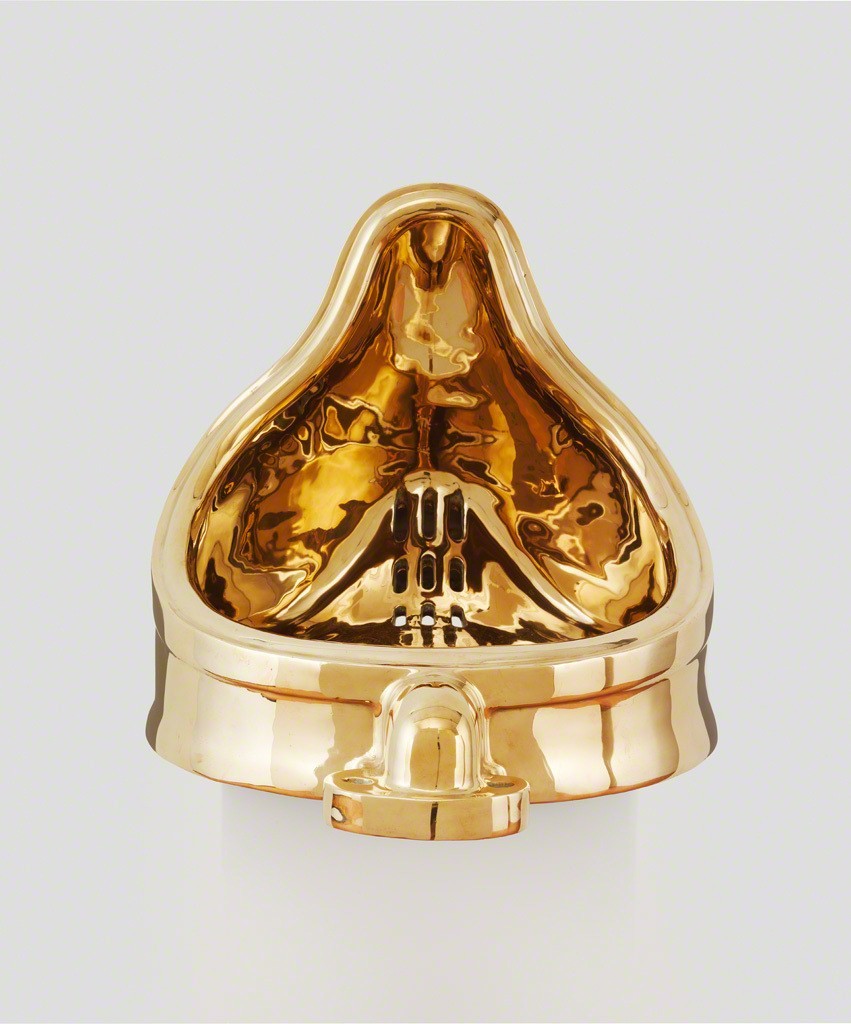
One of the earliest examples of installation art is Marcel Duchamp’s series of ready-mades. I remember the first time seeing Fountain in a museum, a gold plated urinal firmly mounted on a white pedestal. It was a very confusing experience for me. The idea behind this series was based on the principle that objects not considered material art is conventionally made from can be dignified and transformed into artworks through reactions. Hence a gold-plated urinal.


But the idea of evoking reaction from an experience as art has persisted and evolved up to today. Installation art has grown to works like James Turrell’s light rooms, Yayoi Kusama’s obliteration rooms and LACMA’s rain room, to name a few. These works center around evoking reaction through immersive experiences.
“Immersive” to me means that the viewer must be able to experience and sense themselves in the work.
For example, at NCMA’s “You Are Here” exhibit, a piece by Lozano-Hemmer titled “1984x1984” featured a TV wall mounted with cameras that projected a reflection of the viewer’s movements as they stood in front of the wall. The viewer is able to experience themselves through viewing their own movement and form abstracted into colorful squares.


Another example is James Turrell’s “Breathing Light”. While the point of his works are to flood the viewer with color until all senses are seemingly diminished, I would argue that the procedure/experience of entering his piece lends to its immersive-ness. Upon entering, viewers are required to wear the white clean room booties that are provided. This step in requiring the viewer to perform an action therefore inserts the viewer into the piece, making it immersive.
Yayoi Kusama’s Obliteration Rooms and Infinity Rooms are prime examples of immersion. In the Infinity Rooms, the viewer is the center of attention. In the middle of all the flashing lights and infinity is the viewer themself. The focus and draw of her work is being able to see yourself reflected infinite times! (A prime argument of our time’s trend towards the need for self? Maybe. Maybe that’s why the field of immersive installation art has grown. But I digress.) Same as the Obliteration Rooms. The viewer is instructed to place colored dots in all places of the room, “obliterating” all forms of furniture and object in the room. Though a fun concept, it’s made immersive and appealing by utilizing the viewer. Once again the viewer is inserted in the work by performing an action that creates the art.
The Rain Room in LACMA - a contained room that dispenses water from the ceiling, mimicking rain. What makes the work appealing and draws visitors to book their tickets months in advance is that viewers are allowed to - in select numbers - run through the room and get rained on. The art does not exist without the viewer! The experiencer! Other wise it’d just be considered a terrible room with horrendously leaky pipes running across the roof.


All in all, these new forms of immersive-ness in modern installation art are bushing boundaries of how art is defined and experienced. Gone are the days where art was a distant, untouchable, unrelatable object, and here are the days where we the viewers are given the ability to create the art as we experience them.


Citations
1. https://www.lacma.org/art/exhibition/rain-room
2. https://en.wikipedia.org/wiki/Installation_art
3. https://www.lacma.org/art/exhibition/james-turrell-breathing-light
4. https://ncartmuseum.org/exhibition/you_are_here_light_color_and_sound_experiences

Sunday, February 24, 2019

Contemporary Art: a journey of experience

Contemporary Art: a journey of experience


Drooling heat, liquid sunshine dissolving skin — my trip to LACMA in 2013 on a steaming summer day was one of the first few modern art museum pilgrimages I have ever made. As a young artist who was training in pencil, pastel and charcoal, the Levitated Mass — a 340-ton boulder sculpture — captured all of my attention. Trudging back and forth under the “levitated” mass, I could not grasp the idea that an art museum paid 10 million dollars for a piece of rock that does not display any sort of floatation illusion as its name suggests. The rock encounter made me, for a little while, a blatant attacker of modern art. Partly due to the fact that the concepts are mostly foreign, and that I approached most pieces with a consequentialist perspective. 

A few summers ago, I worked at Outsider’s Arts Nanjing as an art instructor. The nonprofit provides space and resources for people who have intellectual or developmental challenges to exercise their creative minds through visual arts. The students drew from pure imagination, utilizing lines, blocks of colors, or even just a single paint stroke. At first glance, the creations may seem to fall far from the common art pieces that we recognize, but the raw sentiments that emerged from those flat canvases allowed me to understand and learned about each student personally even though we often could not communicate verbally. Interactions with the students there led me to ruminate further what art is and could be. In a digital age, cameras capture the reality far better than any realistic paintings. I was inspired to diverge from my obsession with technical perfection and invest time pondering the colors and forms I see in this world. While I still do focus heavily how a painting turns out when I paint, I began to realize a deeper significance in the process of art making rather than the end product.   The art pieces from Outsider’s Arts Nanjing are expressions. They document the thought process, emotions and imagination of artists who are not necessarily concerned with how a painting looks when finished. 

Visual art in the modern age often combine and intertwine with performing arts. For example, the artist Sam Cox, widely known as Mr. Doodle, is invited to draw for big name clients such as MTV and Adidas, often in a live or recorded drawing session, in the form of endless doodles that often lack structure, big design, nor substantial meaning. Sam Cox has gained wide spread popularity over the past few years by stepping out of a conventional art studio and make the art making process an art in itself. What he calls a “growing drawing virus,” he lets his imagination run loose and spill his brain endlessly on a blank surface. In sped up videos that he records, white surfaces of almost anything you can imagine —that of a chair, car, shoes, even his own shirt — are covered completely by cartoonish doodles by the end of the recording, a marvelous spectacle that induce awe and joy in the viewers. Sam Cox draws, but by letting the viewers in on his art making process, he is a performing artist. 

Of course, Sam Cox is not comparable to the students I met at Outsider’s Arts Nanjing. However, the parallel that I see from their artworks is striking. Both see art as a means rather than an end. Artworks to them are chronicles of their feelings, maps of their imaginations. The concept of contemporary art changes and evolves every single day as we as a human species gain experience and step forward in history. Modern art is only becoming ever more diverse. Six years after my first visit to LACMA, both my art style and perspective metamorphosed. I still, however, cannot cease to be confused by the Levitated Mass. 

Black Male Identity Politics in Art: The Black Romantic

        Over the past two decades, there has been a global push to diversify and normalize positive images of blackness in all forms of media. A concept known as the Black Romantic has been used to describe this phenomenon within the Identity Politics art movement. Awareness of Black males in this spectrum piqued when Kehinde Wiley’s portrait of former President Barack Obama went viral on social media platforms everywhere. Even before Wiley’s work, Black Male Identity Politics in art grounded its roots in the Harlem Renaissance era with painter Charles White. 
        His lithograph piece, Gideon, utilized layered line contours to depict realistic depth and phenotypical African American features to articulate alternative beauty standards. The right facing position of the model on the paper makes the viewer interpret themselves looking upwards, in a heroic fashion fitting of the name Gideon, who was a military leader and prophet from the book of Judges in the Bible. Charles White and his artistic repertoire stood in active opposition to caricatures by humanizing African American males and realistically illustrating the beauty of the Black race.           
        White’s abilities extended into his teaching career and inspired a student by the name of Kerry James Marshall. He built an artistic flair of depicting the protagonists as jet black skin tone combined with the bright and vibrant environments, equating outside color value with aesthetic African American beauty standards. A piece most reminiscent of Gideon painted by Marshall would be the Untitled (Stono Drawing), where the male model has a straight on perspective and direct communication to the observer. His mane of thick locs paired with his elaborate white coat indicate a heroic stature. Shoulder poise and facial expression absent of simplicity invoke a deep question of the model’s disposition, stark contrasts of light and darkness gift him strength. 
        Kerry James Marshall continues the lineage of the black romantic and his work influences many present-day artists, such as Kehinde Wiley and William Paul Thomas, a resident artist at the Duke Rubenstein Arts Center. In the art collection of 2013, Kehinde Wiley completed an oil painting named Casey Riley, that maintains similar poise and facial stature that is seen with Charles White and Kerry James Marshall. The model position is more direct than seen in Gideon and is looking left almost as if appreciating a glorious past, basking in the light as it rebounds off of his cinnamon skin. Heroic elements are also present with the gold accent overlay, which is another nod to Charles White and his work. 
        Similarly, artist William Paul Thomas has been working on a collection called Cyanosis, which are illustrations of the societal suffocation imposed onto the Black male in America. Many of the models possess complex emotive stances and vary in age, while maintaining cultural appreciation and the beauty of the Black male. Also, the models are Black males that have contributed to the life of Thomas as well, making a personal connection between them and the world around them through a common experience across generations. 


Works Cited
Charles White (American, 1918-1979), Gideon, 1951. Lithograph in black on ivory wove paper, printed by Robert Blackburn (American, 1920–2003), 338 x 260 mm (image); 509 x 390 mm (sheet). The Art Institute of Chicago, Margaret Fisher Fund, 2017.300 © The Charles White Archives Inc. 
Kerry James Marshall. Untitled (Stono Drawing). 2012. Watercolor, ink, and pencil on paper. Acquired through the generosity of Thelma and AC Hudgins, Donald B. Marron, and Susan G. Jacoby in honor of her mother Marjorie L. Goldberger. © 2019 Kerry James Marshall. 
Kehinde Wiley. CASEY RILEY. 2013. OIL ON CANVAS 48" X 36". 


Defining "Contemporary" Art - John Jernigan


How do we define contemporary art? Often conflated with “modern” or “post-modern” art, the term “contemporary art” does not reference a definite genre or style of art but rather refers to art which is being created today. Unlike modern art, postmodern art, or any other established style, contemporary art exists only in the present moment. This means, of course, that every popular style or school of art has been “contemporary” at some point during its existence. From the perspective of an on-the-ground viewer, contemporary art is a snapshot of the current climate, but it is also a unifying thread which incorporates each movement and moment which together can contextualize what is observed in the present. Since contemporary art is constantly evolving (literally changing by the day), how do we properly understand new artistic trends that emerge every year? How can we correctly define what we are seeing in the moment when our target is moving, and the only thing predictable about what emerges next is that it will be new? Doing so proves to be very challenging even for the most seasoned art critics and historians, but discussing the themes that seem to be increasingly present across new artists seems like a good place to start.

In his article reflection entitled Contemporary Art Trends 2018, George Greenhill of artvisor.com states that one notable trend of very recent contemporary art is that is especially political. Global political and social contention over the past two or three years have given rise to artists creating art that is more overtly and visibly conscientious. Identity and gender politics in particular have played a growing role in the emergence of new artists, with a growing emphasis on female expression and representation, with events such as the #MeToo movement and centennial anniversaries of women’s suffrage in the US and UK providing opportunity for reflection. In Greenhill’s article, he cites exhibitions such as A Woman’s Place (presented by the National Trust’s Women and Power program) and efforts to increase female artist visibility in London’s Tube system (led by Arts on the Underground). This trend is not exclusively observable in the UK, however; the temporary art exhibition currently occupying space in Duke’s Rubenstein Arts Center features works entirely focused around the female reproductive system and encourages its audience to more thoroughly familiarize itself with the cervix. The installation, entitled (In)visible Organ, even welcomes visitors by asking them to step through a door-sized representation of a vagina, which can be seen below.


Increased representation of female artists in popular media is also not restrained to visual arts. Women have also enjoyed increased celebration in the music industry, where they have historically been dramatically underrepresented. In their rankings of the 50 best albums of 2018, National Public Radio slotted an album by a female solo act in each of its top 10 spots, with Janelle MonĂ¡e’s Dirty Computer placing number one overall. In the wake of appalling stories of abuse by producers, executives, and figureheads in the music industry, the importance of this visibility cannot be overstated.

While women creating popular art that celebrates openness and femininity is far from new, (think Georgia O’Keefe and Frida Kahlo), there is a sense that this art is escaping “otherization” and gaining mainstream acceptance. Whether this growing representation has been spurred by a social climate that has encouraged female artists to be more outspoken, or by critical recognition of the glaring disparities in how female and male-created arts are embraced, it is certainly a marked and defining feature of what should be considered “contemporary art.” And, although the current moment is not without its stylistic marks, many of today’s most successful artists embrace traditional techniques but reinvent the works of their predecessors by creating works featuring diverse and representative subjects. For women, at least, the artistic playing field is being leveled, and that is by far the most important characteristic of the present period.


Alex Katz: Coca-Cola Girls (2018)


Alex Katz (born 1925) has been making art since the 1940s. He worked during the latter part of the modern art movement and then transitioned into contemporary art and is still producing art today at 94. In this post, I am going to focus on one of his more recent exhibits at the Timothy Taylor Gallery in London. I had the chance to see this collection in person last semester as part of a modern and contemporary art class I was taking. I didn’t have the chance to write about it then so I am taking that opportunity now.


The exhibit is called Coca-Cola Girls, and the paintings recall themes of the Coca-Cola advertising campaign in the 1950s as well as Andy Warhol’s Coke bottle pieces. Coca-Cola Girls is a exhibition of large paintings, all with Coca-Cola-red backgrounds. They feature the bodies of women in various poses. The painting that greets gallery-goers as they walk in is the only face in the collection. From afar, the skin is painted in two tones, and the girls are all dressed in white. Though the paintings look flat and solid from a distance, getting closer to the paintings allows the viewer to observe tiny variations in color, beyond the few main colors used. By doing this, Katz makes his work stand out from the pop art that it calls back to. The depth of the paintings is there, but must be sought out. Katz allows his viewers to interact with the paintings.


Katz’s paintings offer a modern perspective on the themes behind the original Coca-Cola advertising campaign that reinforced traditional gender stereotypes. There is no outright indication of the connection to Coca-Cola, but Katz uses the distinct “Coca-Cola red” in the background of his paintings.It is only because of the current ubiquity of Coca-Cola that the audience can immediately recognize the signature color. The figures, while obviously female, are not objectified as they were in the Coca-Cola adverts. Instead, they are both liberated and obscured. The women, as seen in Coca-Cola Girl 30, are positioned so that they are open to the viewers.


Coca-Cola Girl 30, Alex Katz, 2018
https://www.timothytaylor.com/artists/alex-katz/#artwork&14963-coca-cola-girl-30

Their body language is energetic, emphasized by the flowing brushstrokes. However, their faces are not visible, making them simultaneously closed off. In just painting the bodies of the women, Katz calls back to the use of women’s bodies for advertising in the 1950s. Viewers are able to simultaneously see the connection to past advertising and women acting freely, which creates a tension in the piece. The complexity of the message makes his work a piece of contemporary art by constantly pushing the boundaries of how we view and connect to art.


In the Coca-Cola Girls exhibit, Katz addresses the ongoing issue of feminism and women’s rights in his paintings. The paintings can be subtle, and require the viewer to analyze them with some background knowledge on advertising history and popular public figures (the white leotards, for example, are based on Marilyn Monroe, and knowledge of Andy Warhol’s pop art pieces with both Coca-Cola and Marilyn Monroe help to inform the viewer of how these two things connect). Even though they refer to artworks and adverts produced during the modern art period, Katz reworks the themes from those pieces and presents them in a contemporary perspective, with the knowledge of current popular culture and also current social issues. Katz is a long-standing figure in modern and contemporary art, and this new exhibit is no exception to the thought-provoking work he produces.


Sources:

“Narrative Bio.” Alex Katz. 2018. http://www.alexkatz.com/biography/narrative_bio

Timothy Taylor Gallery, “Alex Katz; Coca-Cola Girls; 2 November—21 December, 2018,” Press release, (2018).

Brockes, Emma. “Alex Katz: ‘The Smartest People Bought My Work.’” The Guardian. 29 Oct. 2018, accessed 20 Feb. 2019. https://www.theguardian.com/artanddesign/2018/oct/29/alex-katz-interview-painter-banksy

Saturday, February 23, 2019

Contemporary Art through the Lens of Time and Emotion - Rachel Tung

According to NYU’s Department of Art and Art Professions, contemporary art is “part of a cultural dialogue that concerns larger contextual frameworks such as personal and cultural identity, family community, and nationality.” It addresses issues that are relevant to today’s society and the people who are part of it. By addressing these issues through oil paint or sculpture or film, contemporary art provides a focal point around which conversation and reflection can take place.

Based on NYU’s definition of contemporary art, it makes sense that contemporary art is often framed by a time period. I feel that today’s society is especially open about discussing issues related to culture, politics, and identity. Art is another lens or medium through which to hold these discussions and open new conversations. And because these discussions are often sparked by an artist’s story and the audience’s feelings in relation to the artist’s story, contemporary art ends up being very contingent on the human experience. Contemporary art thus has the ability to connect people in a way that is more intimate than other forms of art.

Like many people, my initial understanding of contemporary art was in terms of time; I defined it as art made by artists living today. Through further interaction with contemporary art, I have come to define it in terms of emotion as well. Contemporary art seems to rely on the viewer and his or her background in order to create a uniquely subjective experience. When I think about my own interactions with contemporary art, I have felt uncomfortable at times, and nostalgic at others. Studying abroad last semester gave me the opportunity to think more about contemporary art, as our class took trips to many museums, in Denmark and in The Netherlands.

One vivid memory of a contemporary art exhibit was at the Aros art museum in Aarhus. I cannot remember the name of the artist, but I remember how uncomfortable I felt walking through his exhibit. There were some gruesome pieces, such as sculptures of heads in torture devices and a bloody massacre scene with skeletons and small green army men whose limbs had been torn off. There were also seemingly-harmless pieces like a still-life of a fruit basket, but that, upon leaning in, would reveal Hitler’s signature at the bottom right corner. The exhibit seemed to be a commentary on the immoral, dark side of humanity and the future that would be inevitable if we lost sight of our responsibility to uphold our moral values as individuals and as a species.

On the other hand, there were also exhibits that sparked more positive emotions, such as gratitude and reassurance. At the top of the Aros museum was a rainbow panorama, through which visitors could walk and view the city from above. The glass panels gradually changed from red to orange, blue to violet, painting the city with all the colors of the rainbow. The artist, Olafur Eliasson, described his work as “a space that can almost be said to erase the boundary between inside and outside...this uncertainty is important to me, as it encourages people to think and sense beyond the limits within which they are accustomed.” I was grateful to look at the entire city through a symbol often associated with happiness and hope. Seeing how different the same place could look from different points of view reminded me of the importance of perspective. But more simply, it just felt nice to walk through the panorama and appreciate the beauty of the thing itself. The feelings of gratitude, self-reflection, and contentment as I moved through the panorama stood in distinct contrast to the disturbing discomfort I felt walking through the more gruesome exhibit from before.

I think this range of emotions is what differentiates contemporary art from its predecessors. It has the ability to touch and generate emotions that are so deeply a part of the human experience.

References

Aros: Your rainbow panorama. (n.d.). Retrieved February 23, 2019, from https://en.aros.dk/visit-aros/the-collection/your-rainbow-panorama/

NYU Steinhardt Department of Art and Art Professions. (n.d.). Retrieved February 23, 2019, from https://steinhardt.nyu.edu/art/education/definitions