Wednesday, October 9, 2013

Andy Warhol

During the twentieth century, a time of abstract modern art, Andy Warhol boldly deviated from the norm and took the visual world by surprise by bringing about an artistic revolution. Warhol's work with everyday images such as soup and cereal introduced the power of iconography. With his bold, simplistic approach that transformed commonplace objects and celebrities into historical icons, Warhol was able to capture the very essence of American culture in the 1960's. Warhol brought a mechanical flare into his images that were mass reproduced in his "Factory." He became dubbed the 'Prince of Pop' -- his art brought commercial and popular culture to the masses as the repetitive images became more and more recognized, appreciated, and understood. In this way, Warhol's pop art movement marked the rising era of mass communication.

Andrew Warhola, born in 1928 in Pittsburgh, Pennsylvania, had noticeable artistic talents at a young age. He later received proper graphic design and illustration training at the Carnegie Institute of Technology, becoming the first member of his working-class family to receive a college education. After graduating in 1949, Warhol set off to New York City, aspiring to become a successful commercial artist. Warhol was given a commission by the artistic director of Glamour magazine to design woman's shoes, which soon led to his new persona as a New York designer and the birth of 'Andy Warhol' that had originated from a typo. Warhol was a passionate man with developing obsessions with Truman Capote, shoes, and celebrities. These interests kept his work fresh and constantly changing.


Shoes, 1950's
Ink and dye on paper

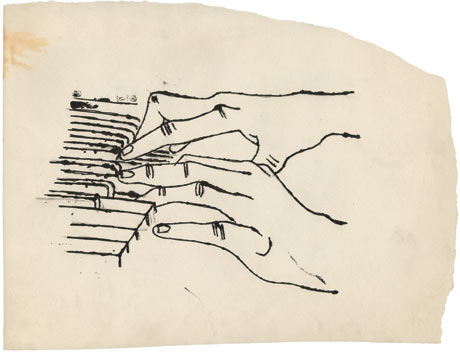
Two hands playing piano, 1954

Face repeated eight times, 1958
When Warhol's success began to wane, his established Andy Warhol Enterprises, Inc. struggled. The business, fashion, and illustrator Warhol might have left, but the pop Warhol had yet to be born. Warhol admired the artists who had exhibits in the Leo Castelli Gallery, who shifted the art world away from Abstract Expressionism by bringing together an assembly of everyday materials and subjects. Little did he know that this would soon launch his new escapade: Warhol wanted to become a painter and and exhibit his work in the Leo Castelli Gallery as well. Warhol began creating his Pop Art iconography. 
Campbell's Soup Can (Pepper Pot), 1962
Casein and pencil on linen
Warhol's style evolved steadily overtime to diminish the idea of an artist's handcraft, instead, he incorporated mechanical printing processes. In August of 1962, Marilyn Monroe committed suicide. This gave Warhol immediate reason to test his photo-transfer technique with Marilyn, a celebrity he had cherished for so long. His obsession with Marilyn resulted in his largest series to date. 


Blue Marilyn, 1962
Acrylic and silkscreen ink on linen
Pop art Warhol was successful and gained increasing attention. In order to accommodate the increasing demands for his paintings, Warhol purchased a former factory building on Union Square as his new studio. This was Warhol's 'Factory.' In the fall of 1964, Warhol was offered an exhibition in the Leo Castelli Gallery. 
Flowers, 1964
Acrylic, silkscreen ink and pencil on linen
At the peak of his fame, pop art Warhol announced that he was moving onto another realm, cinematography. This would start off a whole new Warhol yet again, though the transition from still to moving images was only natural. Warhol's behavior and mannerisms seem to reflect his work very well - taken at surface value, it is shallow and fleeting -- however when taking a deeper look, it is full of meaning and impact. 

Andy Warhol intrigues me because he is one of the most written about artists, and for good reason. Warhol successfully hid himself in his art, or rather, his art became his identity -- constantly changing. People wondered about the "real" Warhol, and thus, he was able to constantly mask his identity and remain mysterious even after being in the spotlight for so long. Warhol created not only multiple personas, but an entire artistic revolution of pop art and iconic images of American culture that lasted, even when Warhol moved on. Warhol is truly inspiring with his motivated mannerisms as well as his philosophy on artistic identity.

Sources
D. Ketner II, J. (2013). Andy warhol. New York, NY: Phaidon Focus.
MacCabe, C., Francis, M., & Wollen, P. (1997). Who is andy warhol?. British Film Institute.
Lanchner, C. Andy warhol. New York, NY: Museum of Modern Art.
Brown, M. (2013, January 20). Andy warhol's unseen early drawings unveiled next week. Retrieved from http://www.theguardian.com/artanddesign/2013/jan/20/andy-warhol-unseen-drawings

Chuck Close

Chuck Close, who was born on July 5, 1940, is an American painter that became famous as a photorealist by making massive-scale portraits. Photorealism is defined as "detailed visual representation, like that obtained in a photograph, in a nonphotographic medium."
Most of his early works are large scale portraits based on photographs of family and friends. Close would work from a gridded photograph and build his images by applying one stroke after another in either multi-colors or grayscale. Some of his early works include:
On December 7, 1988, Close suffered a seizure which left him paralyzed from the neck down, diagnosing him as a spinal injury collapse. Close spent months in physical therapy where he was soon able to make slight movements with his arms. Despite of his injury, Close continued to pain with a brush strapped onto his wrist with tape, creating large portraits in grid squares that are created by an assistant. His works after the injury includes:


Luis Jiménez

"I only reflect what I see and what I have known. As such my work is social commentary."
                                                                                                          -Luis Jiménez

To say that Luis Jiménez simply based his works on Southwestern imagery would not only be a vast understatement, but an inadequate description of how well his works marry both sides of the Mexican-American border in order to articulate the vibrant history of the region as seen through the eyes of a native. Jiménez, “un hijo de la frontera,” traveled around the world as an artist but rooted his style in the American Southwest, concentrating on his life as a Mexican American growing up near the border. Jiménez viewed himself as a social commentator and attributed most of the inspiration for his work to the very events that unfolded before him in his day to day life.

The son of an illegal immigrant born in El Paso, Texas in 1940, Jiménez attended the University of Texas at Austin initially to study architecture, but changed his course of study to fine arts in his fourth year. Over the duration of his life, Jiménez dabbled in a number of subjects including American pop culture and older Mexican traditions in the Southwest.   A keystone theme in a number of his works is the “Honky Tonk” bar scene as depicted in these works entitled, Adeliza’s Candy Store (1983) and Honky Tonk (1981), respectively. 


Jiménez became all too familiar with the bar scene as he often ventured there in search of his father, who unfortunately suffered from the undoubtedly harsh effects of alcoholism.  These pictures, in addition to a number of Jiménez’s other pieces, are done by use of lithograph which, in essence, is a very elaborate method of printing using grease pencil on a stone slab. Evidence of the print can be a bit more clearly seen around the edges of Baile con la Talaca, this 1984 work.


Though lithography was a key medium for Jiménez, he also created a number of fiberglass sculptures that have often been used as public displays.

Southwest Pieta, 1984. fiberglass, 120'' x 126'' x 72''


I was attracted to Jiménez’s work mostly because it is so unconventional. His raw portrayal of sometimes serious subject matter is often coupled with a more whimsical feel, bridging the gap between reality and the surreal. I admire his style because his figures are imperfect and possess realistic shapes and flaws. The women he portrays are very curvaceous and the men are often rugged and brawny. Additionally, I find a number of Jiménez’s pieces to be refreshing in that they are very colorful, creative, and really just fun. Unfortunately Jiménez died in 2006. I believe he would have been a very interesting individual to listen to and watch at work.

Resources:

Flores-Turney, Camille. Howl: The Artwork of Luis Jimenez. New Mexico Magazine,1997. Print.

Anaya, Rudolfo, Shifra Goldman, Lucy Lippard, John Yau, et al. Man on Fire: Luis Jimenez.         Albuquerque: The Albuquerque Museum, 1994. Print.

http://americanart.si.edu/collections/search/artist/?id=2459


Bob Kuhn

Bob Kuhn was born in Buffalo, New York in the the year 1920. As a child he was inspired by the animals at a local zoo, beginning his love for wildlife drawings. Seventeen years later he attended the Pratt Institute, studying anatomy, drawing and design. For over thirty years Bob Kuhn remained a popular wildlife artist.

Unlike many other artists, Kuhn found the line to be the most important part in exercising a drawing. To him "if knowledge is power, then drawing is a means of achieving power in the portrayal of wildlife. It can also be much more." (Bob Kuhn Drawing on Instinct 3) A sure line conveys the knowledge, and the power inside an animal. Although shading is also important, the lines hold the piece together, and convey the meaning behind the piece.


Coyote Chasing Rabbit
Medium: Bold Medium Conte
An illustration depicting the relationship between prey and predator. Kuhn captures the urgency of the scene with long strokes stretching across the page. Instead of focusing on details Kuhn develops the composition and feeling of the piece.

Kuhn also believed that a drawing could be a final product, and are not simply meant to be a preliminary stage to a process. They are interpretations of a subject within the limits given by pencil, charcoal, chalk or ink. Each drawing plants knowledge of the subject in the creators head. The act of drawing is more than simply recording what is seen. It is a continuous addition to the artists mental database and experience.

After 1970 Kuhn turn to exclusively painting wildlife. After a very prolific career Kuhn turned to painting, exploring and honing his abilities. Like his drawings, his paintings were not detail oriented, but focused on impressions and suggestions.


Rubbing of the Velvet- Caribou
Medium:Print on Paper
Despite efforts to get the facts straight in his drawings, Kuhn often had to make up parts of his paintings. Much of the vegetation, background and smaller details have been altered due to his inability to approach the animals.

Over time Kuhn gathered his skills and became more confident in painting. His later works have bolder lines, and more abstract shapes. His works grew from quick animal sketches from expertly drawn lines to fully developed creatures, possessing a form and aura of their own.

Back of Beyond
Medium: Acrylic on Board
Two lions depicted through paint. Sketched in Africa and painted in America.

Kuhn continued painting hundreds and thousands of more animals throughout his forty plus years as an artist. His works have been criticized as having an idealized, and perfect view of wildlife, not portraying the human contamination in the pieces. However, to many others this is a precious body of work that shows wildlife independent and free.

I chose Bob Kuhn due to his broad strokes and lines. I am a very cautious artist, and am always afraid of 'messing up.' Through Bob Kuhn's work I hope to develop more courage when putting down pencil to paper to give more character and voice to my pieces.

Source of pictures and information:
Harris, Adam Duncan., and Bob Kuhn. Bob Kuhn: Drawing on Instinct. Norman, OK: University of Oklahoma, 2012. Print.

Odilon Redon


Odilon Redon (1840-1916) is a French Symbolist artist known for his greatly sensitive and imaginative artworks. While his real name is Bertrand-Jean Redon, he called himself and is better known as Odilon, a nickname that came from his mother’s name, Odile. He spent his early childhood apart from rest of his family, an experience that seems to have created a psychological trauma that later on affected his artworks.
 
Odilon did not lead a successful career as an artist until he reached his forties. He started painting at a young age, winning a prize for drawing at eleven. But until mid-twenties, failure to become an architect and failure to fit into a respectable art studio as his family wished left him with nothing but uncertainties. It was, ironically, a war that provided him a rest from those troubles. A brief but active participation as a soldier in Franco-Prussian War in 1870 gave him time to rethink about his uncertain life. Afterwards, he adopted a more positive and deliberate perspective on his future career as an artist, and began, at last, to produce more expressive and mature works.


Guardian Spirit of the Waters, 1878
 
The Smiling Spider, 1881
 
 
While Odilon’s style went through various small changes, the main stylistic transition occurred in 1890s. Before then, his works mainly consisted of “noirs”, black and white images done mostly in lithography and charcoal. As seen in the examples of Guardian Spirit of the Waters and Guardian Spirit of the Waters, it is clear that Odilon sought creativity in his paintings. I like how his paintings are strangely serene even with monstrous and grotesque subjects. That disturbing yet serene quality was one of the things about Odilon’s paintings that stood out the most to me. He once defined his art as putting “the logic of the visible at the service of the invisible.” Odilon constantly shifts back and forth from reality to fantasy. While bringing out his inner state of mind, he keenly observed the nature to do so.
 
 
Buddha, 1905
 
Yellow Boat, 1910
 
Bouquet in a Persian Vase, 1910
 
 
During the 1890s, a series of events like Odilon’s success at the 1894 Durand-Ruel exhibition and the selling of his old family home in 1897 influenced him to acquire yet another new perspective of life. He became more inventive in use of colors to express his imaginations. Odilon’s “noirs” were gradually replaced by more colorful paintings that were filled with joy and happiness.
 
During the 1890s, a series of events like Odilon’s success at the 1894 Durand-Ruel exhibition and the selling of his old family home in 1897 influenced him to acquire yet another new perspective of life. He became more inventive in use of colors to express his imaginations. Odilon’s “noirs” were gradually replaced by more colorful paintings that were filled with joy and happiness.
 
 
Silence, 1911
 

Silence is one of my personal favorites of Odilon’s works. Silence was among the first Odilon’s paintings I encountered. With this very simple painting of one person in a circular frame, he conveys sorrow, agony, and a stunning “silence” so effectively. The painting’s overall secretive nature, enhanced by the lowered gaze of the figure and the two fingers put on his/her mouth, makes me experience different feelings and thoughts every time I watch the painting.
 
 
Closed Eyes, 1890
 
Closed Eyes is my another favorite. The figure’s closed eyes, typical subject of Odilon, again gives off a secretive silence. But this time, the silence is warm, and it seems like it is there for me to find peace within myself. The softness of pastel enhances the warmness and intimacy of the painting.


Sources
 
<Picture Sources>
Redon, Odilon. Bouqeut in a Persian Vase. 1910. Odilon Redon The Complete Works. Web. 29 September 2013.
Redon, Odilon. Buddha. 1905. Odilon Redon The Complete Works. Web. 08 October 2013.
Redon, Odilon. Closed Eyes. 1890. Odilon Redon The Complete Works. Web. 29 September 2013.
Redon, Odilon. Guardian Spirit of the Waters. 1878. Odilon Redon The Complete Works. Web. 01 October 2013.
Redon, Odilon. Silence. 1911. Odilon Redon The Complete Works. Web. 29 September 2013.
Redon, Odilon. The Smiling Spider. 1881. Odilon Redon The Complete Works. Web. 29 September 2013.
Redon, Odilon. Yellow Boat. 1910. Odilon Redon The Complete Works. Web. 01 October 2013.

<Information Sources>
Druick, Douglas W., et al. Odilon Redon: prince of dreams, 1840-1916. New York: Harry N. Abrams, Inc., 1994. Print.
Hobbs, Richard. Odilon Redon. Billericay, Essex: Little, Brown and Company, 1977. Print.
Selz, Jean. Odilon Redon. Trans. Eileen B. Hennessy. New York: Crown Publishers Inc., 1971. Print.


Ali Cavanaugh


Ali Cavanaugh, born in 1973, seeks to encompass key aspects of both body and soul in each of her realistic and unique watercolor paintings through the use of bold and bright color, pattern, and imagery. Cavanaugh has suffered from great hearing loss, making her dependent on the visual world and unspoken language, enhancing her artistic ability and power. Her painting process is extremely unique, as she paints in the style of modern fresco, applying watercolor paint to plaster panels. She began painting on paper but ultimately, after searching for an alternative surface after paper became more difficult to come by, switched to this historical but still occasionally used style of creating art. She uses bold white negative space in contrast with her stunning colors and figures. Another eccentricity each piece of her artwork possesses is a poetic name, allowing the mind of the viewer to interpret the situation his or her way, but nonetheless guiding them in a certain direction.


again divide the timeline g, 2013


Cavanaugh received the Presidential Scholarship from the David Wolcott Kendall Foundation and was able to study painting at Kendall College of Art and Design before completing her BFA at the New York Studio Residency Program in 1995. Her work has been shown in more than 400 collections and galleries all over the world including the United States, Canada, England, Germany, Portugal, Switzerland, Singapore, and Australia. She has also been featured in many magazines and other publications. Cavanaugh currently resides in St. Louis with her husband and four children.


incomplete circumstance, 2010

I will keep my promise, 2010

attempt, 2013


“I’m constantly in a state of awareness about the world; taking in the imagery, colors, and patterns that to my eye are compositions of settings and people. This keeps me in a place where my perception is enriched by each and every moment.” - Ali Cavanaugh


intensify, 2012

"Ali Cavanaugh." Ali Cavanaugh RSS. WordPress, n.d. Web. 09 Oct. 2013. <http://www.alicavanaugh.com/>.

Post by Tori Bilas