Friday, November 30, 2018

My First Duke Drawing Class - Blog Post #2


Before coming to Duke, I did art nearly every day. From drawing to painting to sculpting to any type of art I could get my hands on. But as soon as I set foot on campus, that passion for art faded a little. I was too busy with soccer; I was too busy with school. So my art fell by the wayside. I went to the arts annex to paint a few times during my freshman year and over the summer I would occasionally doodle a drawing or two. But I didn’t have much free time, and what free time I did have I didn’t have the desire to spend drawing. Perhaps it was that I didn’t see the value in it. Perhaps I thought that it had been such a long time since I had last drawn and I probably wasn’t very good anymore. Or perhaps, starting a new drawing project during a semester full of other academic projects did sounds like an appealing endeavor.
It wasn’t until senior year, fall, when my schedule opened up enough for me to take a class or two that didn’t need to meet a specific class requirement. My dad had always encouraged me to take an art class while at Duke. He knew how much I enjoyed it when I was younger so he always told me he hoped one day I would get the chance to take one in college. This fall was my chance! But I hesitated when I was going to enroll for classes. Why? Well because the art I remember loving was the art that didn’t have a deadline. The art that wasn’t necessarily graded on quality so much as effort. I had no idea how my art would compare to the other people in my class, and I didn’t think I would like being constrained to the assignments and deadlines of a class.
But I decided to go for it. “How bad could it be?” I reasoned, “it’ll be fun.” Besides, I figured, it would be a nice break from the science heavy classes I was used to. So I went for it and I enrolled in my first ever art class at Duke.  And I found, much to me relief, that none of my fears about a college level art class came to fruition. The assignments allowed me more freedom than I expected to draw whatever I wished, so I was able to design a project based on my own interests and draw what I am passionate about. The deadlines forced me to learn how to draw quicker and with more quality in a short time. And finally, I hadn’t suddenly forgotten everything I had ever learned about art and could actually still draw quite well according to my own standards. I expected to find myself in a classroom full of art majors, but I was actually surprised to find myself sitting beside a biochemical engineer who was also taking an art class for fun, just like me!
So, to any Duke student who enjoys art but who doesn’t think they have time to take an art class or who doesn’t think they will be skilled enough or experienced enough to participate, I recommend going for it! Put yourself out there, and be open to try and learn new things, and you just might enjoy a Duke art class as much as I have.

Monday, November 26, 2018

Being an Artist at Duke - Ryan Bloom


I’ve liked art ever since I was a little kid.  I took AP art throughout high school, but I never really thought that I’d continue to pursue art once I started college.  Actually, I never thought that I would really pursue art until my Junior year of college, when I switched my minor from Math to Visual Arts (one of the better decisions I’ve ever made).  Prior to this switch, I had taken two art class at Duke, and I had taken these classes simply because I enjoyed art and had room in my schedule.  I had never thought that I would pursue it any further.  Therefore, prior to deciding to minor in Visual Arts, art didn’t really play a big role in my life at Duke.

However, as a senior, this trend has really taken a changed.  Upon deciding to minor in Visual Arts, I realized that I needed to take 4 more art courses over the next two semesters.  I’m really thankful for this because I was able to explore more art forms other than drawing, which is really all that I had explored throughout High School and my first 3 years at Duke.  Upon searching for my courses at Duke, I learned about how wide a range of art courses and mediums there are at Duke, which is really great for everyone interested in the arts.

This semester, I am taking 3 art classes, and art has therefore played a much larger role in my life, which I am very thankful for.  I love spending time drawing just to relax and unwind whenever I can.  I’ve also gotten the opportunity to learn a lot about animation and graphics in motion from the two other art classes that I’m taking (besides Intermediate Drawing).  I’ve had the pleasure of taking a class in the new Rubenstein Art building, a beautiful place to work, and have had the ability to combine my interest in technology with my love of art through my Graphics in Motion course.  I’ve enjoyed all of my courses and have learned that there is a much larger constituent of artists at Duke than the average student (or that I, prior to switching my minor to Visual Art) might know about.

However, one thing that I have noticed this semester is that the art students might sometimes feel separated from the rest of the student body.  I have personally noticed this due to the fact that I am taking only art courses this semester, and therefore have no classes on east or west campus (as 2 of my classes are in Smith Warehouse and my other class is in the Rubenstein Art building).  Additionally, the work that I do outside of class rarely requires me to go to a library and often requires more room to work.  This, combined with the fact that I live off campus has led to me spending less time on campus than in previous years.  However, this doesn’t have to be the case for all artists if they spread out their courses over their years at Duke and make it a point to work on campus when they can.  Overall, being an artist at Duke has been an amazing experience and I am so happy with my decision to pursue the Visual Arts minor, and I hope to continue with this passion upon graduating in May!

Wednesday, October 31, 2018

Blog post 2: Creating art community at Duke


Despite the frenetic pace of life at Duke which makes it hard to find breathing room and space to reflect and create, I haven’t relinquished the arts easily because of two things. The first is my continued involvement in visual arts programming through DUU. The second is that I remember what it was like to belong to an art community and am trying to create that for Duke students who don’t have a formal art community through art classes.

Throughout middle school and high school, I spent 3 hours a day in the art studio, the air suffused with turpentine, every available surface coated with plaster or subtly smeared with oil paint that invariably found its way onto my clothes. Before the school bell rang, my classmates would nap on the couch in the studio; between classes (and sometimes during class) we came to the studio to work on whatever hellishly ambitious assignment was due that week; after class we would put on the music, make instant noodles from the convenience store in the microwave, and paint till 11pm. Against the teacher’s orders, we left the back door in the ceramics studio open so we could sneak back in on Sunday to keep reworking our homework. I carried a sketchbook everywhere I went, documenting my life and thoughts as it happened.


Art has become core to my sense of self. As a practice and process, it’s meditative and allows me to set everything else aside to focus on the act of creation. When I flip through my sketchbooks, accumulated over the years, I have a clear chronology of my life, or at least the times in my life that I deemed memorable enough to document (when I had time, or in spite of having no time). In an environment where my strongest impulse is to rush blindly from place to place, to do the next thing and get it over and done with, art gives my life, small and insignificant as it is, structure and meaning.

Contrary to the common perception that art is an individualistic endeavor, I think community is fundamental to the process of art making. Peer critiques help us see what we could be doing better, and also give us an opportunity to be inspired by other people’s work. More importantly, it is so much easier to be committed to an artistic practice when it is bolstered by friendship. Without peer influence, it follows that unless you have an enormous amount of conviction and willpower, the visual arts as a proportion of your time and your life become vanishingly small.

Against that backdrop, the work that I do with DUU VisArts and Draw Durham—trying to build a real arts community at Duke through sustained rather than ad-hoc programming—feels fundamentally countercultural. Creating arts community is nothing less than asking Duke students to slow down, show up, and take as much time as they need—not as much time as they have—to be present to their own experience.

Tuesday, October 2, 2018

Micheal Head. Simplifying a few things


Perhaps the best thing (or at least, my favorite thing) about the development of art is what some call the “deskilling” of art and the gradual shift away from “the artist as craftsman” after the end of the Renaissance. Perhaps the worst (and my least favorite) development, in contrast, is the idea of “the artist as individual,” in that the artist is both a mysterious, tormented Gogh-like figure and a genius whose mind and work should be exalted. All of these nuances are confusing, and thinking about them gives me a headache.

It doesn’t help that we have thoroughly latched onto various views of the “artist” such as these, many of which contradict: Artists are naturally gifted and draw inspiration from thin air. Artists are geniuses with an insane repository of imagination floating up in their head. Artists should be humble. Artists should be proud of their accomplishments. Artists don’t do any real “work.” Art that takes less “work” to create is worth less than art that did. Art is a labor of time. Art is an inspired creative act. Art is a skill and physical activity. Art should come from the heart. None of this is any good.

In actuality, it’s simple: people make stuff, art or otherwise. People look at stuff, art or otherwise. When you look at interesting stuff, it influences what you want to make and look at. When you make different stuff, that influences the stuff you then want to make and look at. This is true whether you’re writing a research paper or speaking in public or digging holes in the dirt of your preschool playground or vomiting former meals onto the bathroom floor. Art is like all these: it’s an exercise in experience. More experience gives us the breadth and depth of knowledge to generate new, hybrid experiences. That's it. The only time it may seem otherwise is when you forget: when a non-artist sees an artist and thinks they pull from either thin-air or their own genius, or when I look at an artist I admire and wonder how they thought of ideas so beyond my own, or when someone sees an artist’s work and either doesn’t understand or doesn’t care about the value the work has to that individual. This simple mechanism is why some artists latch onto social/political statements, while some latch onto representation, while some latch onto form or technique, while some deviate wildly, while some do their own thing. The inner mechanism is simple, yet the aggregate results are complex and interesting.

This may still seem like an unnecessary argument. You might be right. I may come off as angry or sassy. You might be right again. Though, if I am, it’s not at any thing, person, or institution in particular. Maybe you think I’m just trying to be humble, in which case I’d like to point you to the beginning of the essay and ask you to reread from the top. Or, maybe this is just common knowledge—I’m just saying obvious things. But this is my essay about contemporary art, and this is me speaking about something as general as possible while still drawing from experience. And my experience tells me that this is not common knowledge and people do not think these things are as simple as they are. The fact that we often overcomplicate (myself included), perhaps indicates more about our attraction to overthinking simple things and applying patterns to chaos, than about the overwhelmingly simple act of making and looking. I think we’d all be better off if we just simplified things a bit.

Monday, October 1, 2018

Out of Your Comfort Zone: Contemporary Art by Kathleen Embury

Modern Art.  Two words that inspire a spectrum of strong opinions and feelings--of disdain, disgust, adoration, confusion...the list goes on.  But what really is "Modern Art"?  When people form their views, do they really understand what it is as a genre?  Can it even be called a genre?  Every period in time had it's own version of "modern" art, simply due to the style in fashion during that period.  "Modern Art," or Contemporary Art, is a sweeping term that covers so many different styles of art across the globe.  So can it really be categorized as a genre in and of itself? Though there may not be a truly straightforward answer, we can look back at it's origins to give some clarity towards the definition.

Modern art can largely be traced back to the beginning of the Industrial Revolution, in the 19th century, when all these new technological advances, manufacturing, and better transportation allowed for greater urbanization and the spread of ideas.  With all these advances, people's worldviews were broadened, and they had more time to explore new ways of expressing themselves through art.  Artists no longer were simply employed by wealthy people or the church to depict realistic or religious stories, but people started to appreciate different ways of looking at the world according to the artist's individual outlook.  This included Impressionism, often noted as the first "modernist" style, as most famously depicted by Monet.
Image result for monet sunrise
Impressionism, Sunrise by Claude Monet, 1874, oil on canvas


Monet focuses on the light and movement that he experienced in the moment of painting, a hallmark of the style that was unheard of, inspiring criticism at the time (as is the case with most new styles.) 

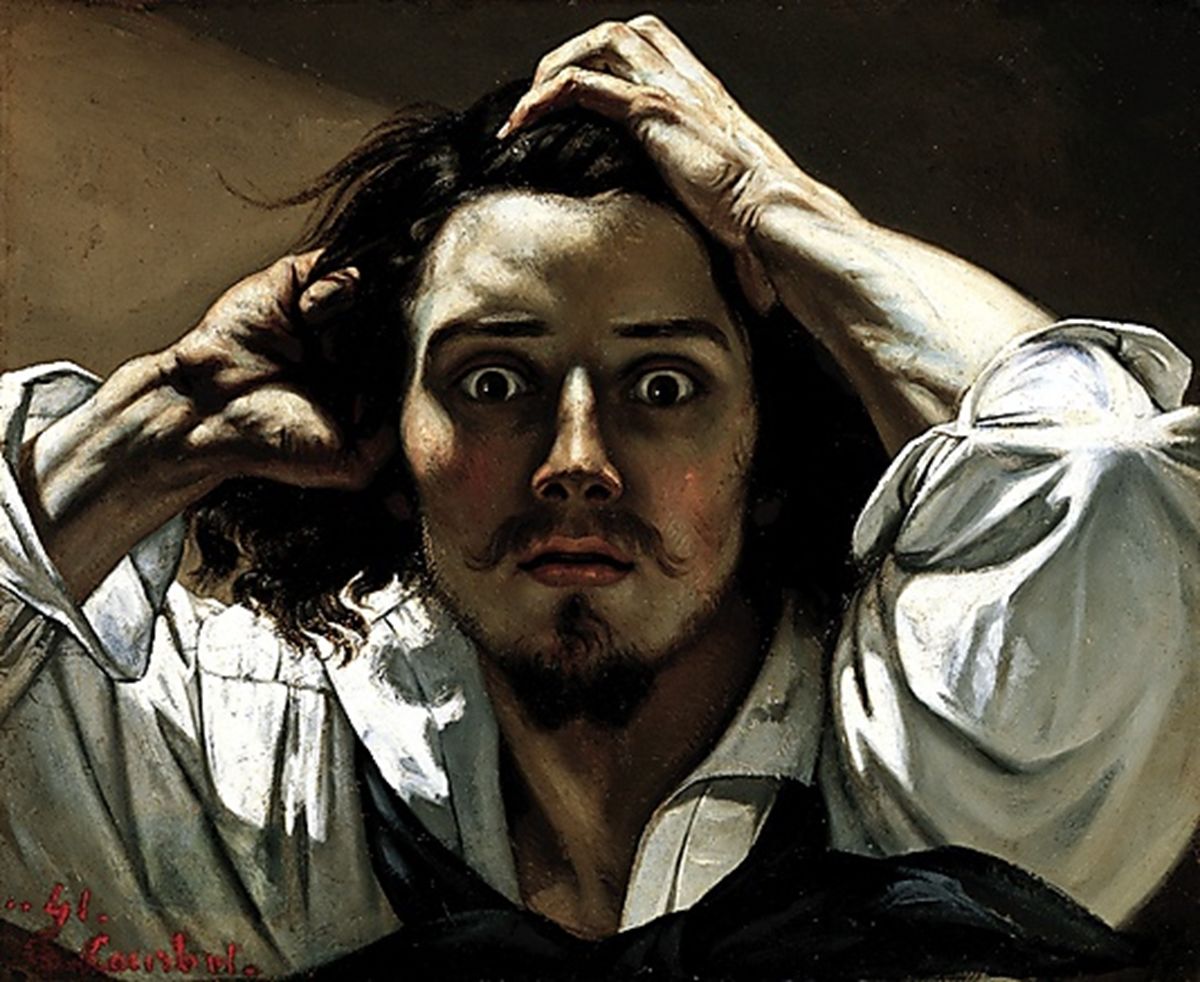
Several other styles would follow as urbanization grew and artists began focusing on cities and common life as subjects.  Realism was one such style, which aimed to depict people and places as they were with all their imperfections.  Gustave Courbet is one example of a Realism artist.


Image result for gustave Courbet art
Le Desespere by Gustave Courbet, 1845, oil on canvas, a self portrait 


Countless other named styles bloomed from these genres as technologies and advancements spread across the globe.  Artists began depicting subjects in even more abstract ways, such as with Picasso's works and notably Duchamp's Fountain.   Some art, such as Warhol's Marilyn Diptych, was used to depict images from the media.  Many modern works of today have an underlying message pertaining to a social issue.

I was in New York this past summer, and though I didn't have a chance to visit the MoMA, I did go to the Whitney and the Brooklyn art museums, which have a large variety of stunning and thought-provoking modern works.  This modern art explored different media, including film, audio, photography, using all sorts of materials like string across a room at specific angles, and every combination.   Artists are exploring combining topics from other principles, such as math or science, and showing how they can be used to create art.  The very concept of what is considered art is challenged. Some such examples I saw from the Whitney are depicted below.
Sine Curve Man by Charles Csuri, 1967, ink on paper, outputted by a plotter

Five Words in Green Neon by Joseph Kosuth, 1965, neon tubing


But what we associate with Contemporary Art nowadays may not always be known as "Modern Art."  Perhaps in 50 years it will be called something else, categorized as its own genre in art history.  Though we think of Modern Art as this foreign, avant-garde style, this is exactly what makes it so impactful: it's new.  It's often uncomfortable. It's remembered.  And isn't that every artist's ultimate goal?

Note:  It should be noted that this is an extremely brief and narrow look at the history of Modern Art and what it is today.  There are so many styles that were not explored, particularly from other parts of the world than Europe and North America, and from women.  It is interesting that such works and artists are not as widely discussed in the sources I found searching for "Modern Art,"  but that is a topic for another day. 

Sources:

https://www.moma.org/learn/moma_learning/themes/what-is-modern-art/
http://collection.whitney.org/object/57415
http://collection.whitney.org/object/8377
https://www.metmuseum.org/exhibitions/listings/2008/gustave-courbet
https://www.wikiart.org/en/gustave-courbet/the-desperate-man-self-portrait-1845
https://www.theartstory.org/definition-modern-art-artworks.htm#pnt_1
https://www.1st-art-gallery.com/Claude-Oscar-Monet/Impression-Sunrise.html

Probably closer to stream of consciousness than a rant (barely)


Contemporary art, to me, can be divided into a few broad categories: the type that focuses on looking good, the type that focuses on looking horrible but new, and the type that tries to convey a message about society. Or, in other words, the good, the bad, and the ugly (truth). I happen to fall into the camp that values form, lighting, anatomy, and so on, and as such, I really don’t like the attempts at art some artists have made, and I don’t value their contributions in the slightest, no matter how many people try to explain how something has been deconstructed or pushed the boundaries of art. It’s a personal type of selfishness, sure, but I’ll go through why I think this way. To begin with, I think the idea of being avant-garde is an excuse to not develop one’s concept into something that stands alone in skill. Rothko pushed the boundaries of art by deconstructing painting into primary colors and rectangles, but he only took the outrage over it as evidence he was doing something right, apparently, because he continued to do the same thing until more people gave up and accepted it. And, just to mention the common point against it, being successful in this camp relies a little too much on publicity and luck. The argument of “if it’s so easy to make avant-garde art, why don’t you do it first”, which always finds a place into the arguments of free-thinkers, is too dismissive, and doesn’t justify the fact that the most artists don’t try to further encrypt their work into being unreplaceable. For example, in pieces that use wild brushstrokes like anything from Jackson Pollock, the only barriers are the trends of organization unique to them as they try to do something randomly, and this isn’t intentional enough. Although I suppose Jackson Pollock’s splatter paint technique became unique over time as he probably developed muscle memory from doing it so many times, people can still mimic that well enough to fool the average person, who is all that really matters when it comes to art. My complaint is that development for the avant-garde artist stops at the revelation of a new abstraction or deconstruction, basically. Speaking of the average person, this ties into why I don’t like art that tries to convey a sociopolitical message, but it earns a little less distaste from me than avant-garde work. It simply won’t be understood by every person unless the piece abandons subtlety and becomes more of an exaggeration than a public experience. I find that politics being mixed in with everything is also just exhausting, to the point where I’ll dismiss something for being an overdone topic. But, at least political art still tries to inspire something in the viewer, and occasionally goes for depictions of form and scenery. Nonrepresentational art tries to invoke emotion too, but I think its fundamental error is its defining feature: that it excludes people or makes them unrecognizable as such by ruining their features. Ultimately, art is for people, and if it is to invoke emotion, it must be something that can be empathized with and understood without an attached essay explaining the scrambled mess. For countless years, humans have been depicted in art realistically, and certainly not with total accuracy. Just consider the exaggerated musculature of Michelangelo’s portrayals of humans, and how they still captured the hearts of viewers. The development of photography may have stolen realism’s main selling point but giving up on all degree of accuracy to convey a message is not the solution.