Wednesday, February 22, 2017

John Everett Millais (1829-1896) - Mary Lin

John Everett Millais was one of the most celebrated and successful British artists of the 19th century. He was born in Southampton, England in 1829 into a moderately wealthy family that supported his artistic training from an early age. At age 11, he was the youngest pupil to enter the Royal Academy School in London, and subsequently became a star student, winning several awards for his drawings and paintings. In 1848, Millais became one of the Pre-Raphaelite Brotherhood’s founding members, along with artists William Holman Hunt and Dante Gabriel Rossetti. The group was inspired by paintings dating prior to the High Renaissance (~1500), and sought to rebel against the academic conventions taught by the British art establishment of the 19th century. Their style was characterized by the use of vibrant colors, fine attention to details, and complex compositions.

In the 1850s, Millais gained celebrity through his successes in book and periodical illustration, creating over 300 images in total. He also participated in the Aesthetic Movement in the 1860s, and in doing so contributed to a renewal of interest in decorative art of the 18th century. By 1870, he had established a successful business in portraiture, allowing him to achieve great wealth and status. Alongside his portraiture, Millais continued to produce a wide variety of paintings, including landscapes as well as those focusing on historical and religious subjects. After briefly serving as President of the Royal Academy, he passed away in 1896, and is buried in St. Paul’s Cathedral.


Ophelia (1851-1852), oil on canvas

Ophelia is one of Millais’s most well known works from his Pre-Raphaelite period. The painting depicts a scene from Act IV of Shakespeare’s Hamlet, in which Ophelia drowns herself in a stream after Hamlet murders her father. From July to October of 1851, Millais spent up to eleven hours per day painting at a river in Surrey, and carefully observing the elements of nature that are included in the painting. The style of this painting was unique in that it depicted a Shakespearean character with an intense realism in a natural, rather than theatrical, setting.


Study of the Head of Elizabeth Siddal for 'Ophelia' (1852)

Ophelia also speaks to Millais’s great talent for portraiture. He has been observed to create portraits by placing the sitter and the canvas side by side to allow for more direct comparison, and his depiction of the sitter, Elizabeth Siddal, was praised for being the most accurate likeness of her ever made. His skill and sensitivity is also evident in the study of the head for Ophelia, shown above, a drawing that is complex and remarkable in its own right. It departs from traditional conventions of portraiture in that the subject’s gaze is diverted, and also highlights the unique qualities of the sitter, such as her pale eyelashes. 
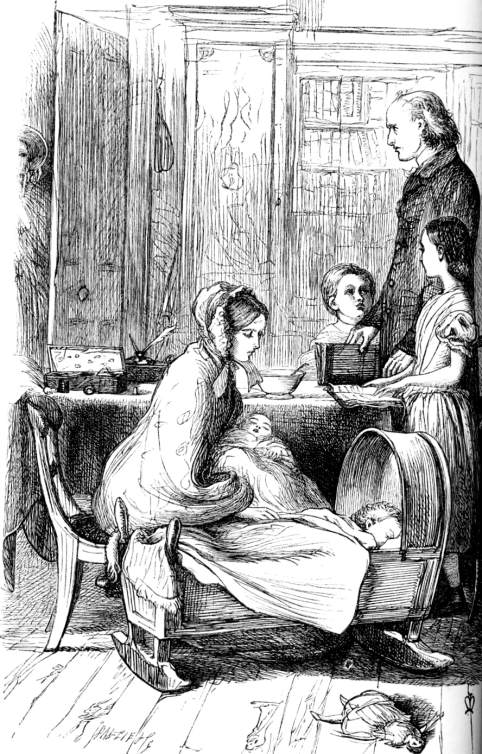

The Crawley Family (1860), illustration for Anthony Trollope's Framley Parsonage

Millais produced the above illustration for Anthony Trollope's novel, Framley Parsonage. Millais and Trollope had a sustained collaboration, with Millais illustrating six of Trollope's novels. Millais is recognized for his skill and versatility in textual interpretation, which allowed his illustrations to enrich the written material. The Crawley Family exemplifies how Millais used symbolic details to support or add more dimension to the text. As noted by scholar Simon Cooke, its placement of the cradle at the base of the drawing and of Crawley at the top serves to highlight the journey from youth to adulthood, and the cycle of life.


Leisure Hours (1864), Oil on canvas

Leisure Hours is considered to be one of Millais’s contributions to the Aesthetic Movement, and reflects his interest in abstract beauty. The painting depicts Marion and Anne Pender as part of an arrangement of decorative and beautiful objects. Close attention is paid to the ornamental details, such as the lace trim and red velvet of the dresses, the green textile floor, and the Spanish leather screen in the background. 


Louise Jopling-Rowe (1879), Oil on canvas

Though this portrait was created after his time in the Pre-Raphaelite Brotherhood, it still shows traces of Pre-Raphaelite influence in its refusal to flatter and idealize the subject. Unlike that of other portraitists of the time, Millais’s works are not theatrical or flamboyant, but rather use reserved poses and pay closer attention to the sitter’s individuality.
 
I chose to study Millais because I am fascinated by the coupling of the beauty and skill of his portraiture with his lush, decorative depictions of the surrounding environment. I first became interested in his work after seeing Ophelia at the Tate Britain in London, which impressed me with the ethereal quality imparted on its sitter, as well as the intricately detailed and delicate renderings of the natural setting. The complexity of Millais's compositions brings a multi-dimensionality to his paintings that is particularly compelling. It is also interesting to me how his work challenges artistic conventions in portraiture, particularly through its nuanced realism and focus on the sitter's idiosyncrasies. 

References:

Cooke, Simon. "John Everett Millais as an Illustrator — Significant Gesture, Expressive Line, and Emblematic Detail." The Victorian Web. 11 Nov. 2009. Web <http://www.victorianweb.org/art/illustration/millais/cooke.html>.

Cruise, Colin. Pre-Raphaelite Drawing. New York: Thames & Hudson, 2011. Print.

Riding, Christine. John Everett Millais. London: Tate, 2006. Print.

Goldman, Paul. John Everett Millais : Illustrator and Narrator. Eds. Birmingham City Museum and Art Gallery, Leighton House, and Tessa Sidey. Aldershot, Hampshire: Lund Humphries 2004. Print.

Eugene Delacroix - The Master of Color

Ferdinand Eugene Victor Delacroix was a French painter largely known for his impact on the Romantic movement of art. His works tend to forgo clarity of outlines and instead emphasize color and movement. His expressive brushstrokes bring out the subject of his paintings with extreme visual clarity. The result of his artistic methods is paintings with rich, vivid color palettes.


Self portrait by Eugene Delacroix, 1837

A common occurrence with Delacroix is the impact of his travels on his works. His visit to Morocco seems especially influential on his late works. For example, his work Fanatics of Tangier, was based on a riot incited by a Muslim sect that he witnessed in Tangier, Morocco. Similarly, many of his other works in the late 1830s were sketches of scenes from Tangier. These subjects are those that Delacroix found himself returning to. For example, works like The Lion Hunt (1861) or Arab Saddling His Horse (1855) are later works that have clearly drawn influence from his travels.

Arab Saddling His Horse, 1855
Fanatics of Tangier, 1838

These works are very representative of the early 19th century Romantic style. Rather than using literary or historic subjects as in the Neoclassical style, Romanticists such as Delacroix captured the zeitgeist of their current times. Although his late works are essential to the Romantic style, Delacroix's most influential was Liberty Leading the People in 1830. In this work, Delacroix depicts a scene from the July Revolution of 1830, resulting in an uprising that crowned Louis Philippe I, nicknamed Citizen's King.


Liberty Leading the People, 1830

The image itself is of Parisians fighting under the tricolor flag that represents liberty, equality, and solidarity. Delacroix was inspired by the events and captured the spirit of liberty that tries convey the will of the French people. In contrast to the armed men and dead lying around her, the female figure is a device used to convey the idea of liberty.

I have long been a fan of Romantic art and Delacroix, one of its leaders. Most attractive is the bright and lively imagery. As I discussed, Romanticism tends to depict events contemporary to the artist's time, acting like a window into the past. Seeing the everyday events of a time long past is an interesting experience that draws me to the style of Delacroix.


1.  https://www.khanacademy.org/humanities/ap-art-history/later-europe-and-americas/enlightenment-revolution/a/delacroix-liberty-leading

2. http://www.eugene-delacroix.com/the-fanatics-of-tangier.jsp

3. https://collections.artsmia.org/art/1978/convulsionists-of-tangier-eugene-delacroix


Salvador Dali: Kevin Mo

Salvador Dali, born in Catalonia, Spain in 1904. At the Madrid's school of fine arts, Dali became drawn to Academicism, Impressionism, Futurism, and Cubism. He also began to read Freud's work and became enamored by the subconscious and joined the Surrealism movement in 1928. As one of the most famous Surrealist painters, Dali developed the "Paranoid-Critical Transformation" method as the main means by which he drew inspiration for his work. Through his method, Dali was able to place himself in a "paranoid" state where he could experience hallucinations regarding everyday objects and life. I became first aware of his work while visiting his museum in Paris and became immediately drawn in by his ability to make subconscious connections between different ideas that I personally would not be able to connect but can appreciate. 

One of the major themes across many of his artworks is time and our perception of it. In arguably his most famous piece, "The Persistence of Memory", Dali displays a multitude of melting clocks where it time is fading into oblivion. In this imagery, Dali could be making a statement on time in a dreamlike state fading or how memory can persist while time passes and melts away.


"Persistence of Memory" [1]

Often times, after returning from his "paranoid" state, Dali would want to immediately sketch out his hallucinations. Below is a sketch called "Fantastic Beach Scene" where there is a strange placement of arms within the sketch. It is cool to note his use of line thicknesses to accentuate important portions of each object and how they bring certain objects to the forefront and push some objects to the back.


"Fantastic Beach Scene" [2]

Another one of Dali's infatuations was the use of animals, specifically the elephant in his paintings. In this painting, "Swans Reflecting Elephants", the first thing that stands out are the swans basking in the lake. Upon further inspection, we see the reflection of the swans which like elephants. This hallucinatory imagery was a main staple of Dali and the surrealism movement where things can take on a second within the painting. 


"Swans Reflecting Elephants" [3]

Impressionism as a genre has always been a favorite of mine as it is closest to my style of painting. However, surrealism and Dali provides an extra layer of thought and introspection that doesn't exist in impressionism which I really enjoy from an observer's standpoint versus a learning standpoint I might take when viewing impressionist paintings.

Citations:
1. http://legomenon.com/salvador-dali-persistence-of-memory-melting-clocks-meaning.html
2. https://www.masterworksfineart.com/artist/salvador-dali/fantastic-beach-scene/
3. http://totallyhistory.com/swans-reflecting-elephants/


Yayoi Kusama
by Krysia Sikora 


Yayoi Kusama is a Japanese artist and writer who is known for her unorthadox style that often exhibit repeating patterns and psychodelic imagry.  Kusama works with a variety of mediums including painting, printing, sculpture, and both performance and instilation art, often evoking themes of sexual anxiety, feminism, obsession, destruction, and deep self reflection throughout her work.  Today Kusama acknowledged as one of the most influential living artists to come out of Japan and an important voice for the avend-garde movement.  

Kusama was born March 22, 1929 in Matsumoto City Japan and began painting at around the age of ten.  According to Kusama, she turned to painting as a means to escape childhood neglect and her early experiences with hallucinations, many of which included visualizing fields of polka-dots, a theme that she famously for depicts in much of her work.  

At nineteen, she left home for Kyoto, where she studied the traditional Japanese style of painting known as Nihonga, and also began experimenting with abstraction.  However it was not until she arrived in the United States in 1957, that her career took off. Inspired by a letter she received from Georgia O'Keefe, Kusama moved to New York to persue a career as an artist.   

From 1958 to 1973, Kusama honed in on her signature polka dot and net motifs, developed soft sculpture, and created installation and performance based works around the city. 


Dots Obsession, 2013

During her time in New York Kusama also became a very controversial avend-garde figure.  She staged provocative performances throughout New York, which often included featuring public nudity, as a form of anti-war activism.  


Anatomic Explosion, 1968


For example, at the height of the Vietnam War, Kusama staged the Anatomic Explosion, which featured nude models dancing opposite the New York Stock Exchange.  Her performance was prefaced by press statement, ‘The money made with this stock is enabling the war to continue. We protest this cruel, greedy instrument of the war establishment.’

Additionally during her time in New York, Kusama first started using mirrors and reflections in her art, and later developed her famous Infinity Mirror Room, and exhibition that is featured in many museums today.  In these complex instilations, the room is lined with mirrors, and numerous lights and colored balls hang at various hieghts above the viewer.  The arrangement of the mirrors and the instillation's lights creates the illusion of a never ending space and celestial environment.  


Infitity Mirrored Room, Broad Museum in Los Angeles


 All the Eternal Love I Have for Pumpkins, 2016


After her time in New York, Kusama moved back to Japan to continue her work featuring her iconic dots, mirrored rooms, and expressive patterns.  She has been honored with the Ordres des Arts et Lettres from the French Ministry of Culture, as well as the Praemium Imperiale prize from the Japanese Art Association.  

I was first exposed to Yayoi Kusama's work, when I went to her Infinity Mirror Room the Broad Museum in Los Angeles. I have always been drawn to more modern art, however I love how Kusama makes most of her work interactive, therefore the viewer actually moves throughout her scuptures and in a sense becomes a part of it.  I also was especially intrigued by her use of mirrors and reflections in a lot of her work.  For example in both her Infitity Mirror Room and All the Eternal Love I Have for Pumpkins the mirror instilation effect gives you the feeling that you are in a cosmic galaxy, which is eternal.  Additionally as I did more research on Kusama I really enjoyed learning about her performance art pieces that were a response to the Vietnam War, because it showed that she used her art to make a statement, although it was controversial. 


Links 

http://www.tate.org.uk/context-comment/blogs/kusama-and-anti-war-activism

https://www.moma.org/artists/3315?=undefined&page=2&direction=fwd

http://hirshhorn.si.edu/kusama/yayoi-kusama/#infinity-nets

http://www.artnet.com/artists/yayoi-kusama/biography

https://www.britannica.com/biography/Yayoi-Kusama

Andreas Vesalius/His Draftsman (1514-1564) - Varun Gudapati

Andreas Vesalius is credited with the establishment of modern human anatomy. He was born in Brussels, Belgium in the Holy Roman Empire and spent most of his career in Padua, Italy (at the University of Padua), the center of the most rapid and meaningful medical advances of the time. Here, Vesalius was able to academically study anatomy; he was even given access to human bodies for dissections, which was a privilege that was unlikely to have been granted anywhere else in the world. None of his historical predecessors were allowed to work with humans, perhaps explaining why Vesalius was the first to describe anatomy with a degree of accuracy acceptable even today.

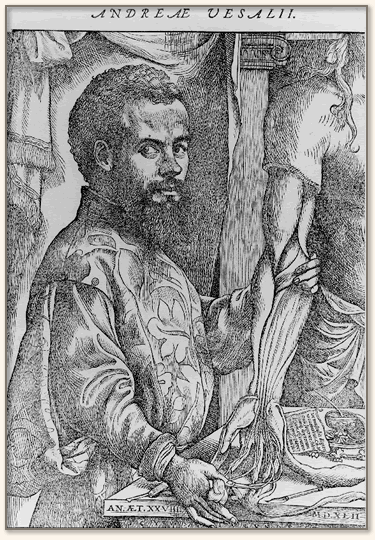
Portrait of Vesalius from De Humans Corporis Fabrica (DHCF) drawn by someone else.

Drawings, engraved in woodcuts, were the most important means of documenting his findings. It is likely that Vesalius worked with a draftsman to produce these drawings, but I chose to write about Vesalius because it is unclear who he worked with and because he is known to have planned all of them. Vesalius published De Humans Corporis Fabrica (The Fabric of the Human Body) in 1543.

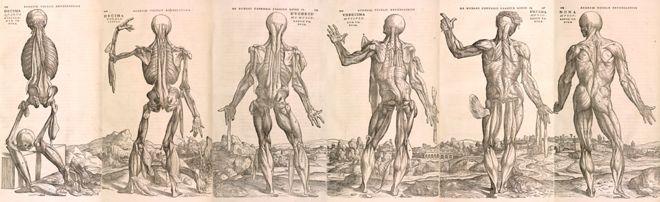
Drawing of male musculature from DHCF.

The drawings in his book were influenced by Renaissance practices, particularly the way that shading was used to make literal and accurate representations and the fact that they were printed using woodcuts. For this reason, his book is of great value not just to the medical community but also to the artistic one.

Drawing of skeleton from DHCF.

A body suspended against a post from DHCF.

A series of positioned cadavers showing human musculature from DHCF.

These drawings tend to depict skeletons or cadavers in natural and lifelike positions rather than simply "on the table." Vesalius believed that the human body is art, which might have influenced the decision to use these positions. Additionally, the variety of positions enabled the users to see how the muscles could change, meaning that readers could see the movement of muscles through static drawings.

I chose Vesalius (again, even though it was likely an unknown draftsman who did most of the final drawings) because he combined art and the sciences with critical proficiency in both. I have a special appreciation for the drawings of De Humans Corporis Fabrica because they accurately capture the anatomical structures in a way that has helped advance medical care for centuries while being beautiful from an artistic standpoint. It's not just the realistic shading and lines that appeal to me but also the creative and lifelike positioning of the cadavers. Though the varying positions of the bodies has medical relevance because they capture the dynamic aspects of anatomy, the scenery and surrounding details put in the drawing seem to serve an entirely artistic purpose. I think that drawing people is one of the most challenging skills that I hope to have one day, and seeing a person build from within (anatomically) has given me a new perspective.

References

Raphaël Cuir. The development of the study of anatomy from the Renaissance to Cartesianism : da Carpi, Vesalius, Estienne, Bidloo. Lewiston, N.Y.: Edwin Mellen Press, (c)2009.

"Andreas Vesalius (1514-1564)." BBC History. http://www.bbc.co.uk/history/historic_figures/vesalius_andreas.shtml

"Andreas Vesalius." Anatomy in the Age of Enlightenment. University of Michigan. http://www.umich.edu/~ece/student_projects/anatomy/people_pages/vesalius.html

"Comparative Anatomy: Andreas Vesalius." Understanding Evolution. http://evolution.berkeley.edu/evolibrary/article/history_02


Tuesday, February 21, 2017

Frank Lloyd Wright (1867-1959) : Jessica Zhang

Frank Lloyd Wright was an American architect (and interior designer) born in Wisconsin in 1867. Having designed over 1114 structures, 532 of which were realized, Wright created some of the most innovative spaces in the United States over his seven-decade career. His works features "organic architecture"--emphasizing the need for harmony between humanity (buildings) and nature (its surroundings.) Most of the homes he designed were "prairie style" and one that later became known as the Usonian style.

Wright's childhood was "nomadic", as his father would travel from a ministry position to another throughout the Central and Northeast United States until they finally settled down in Madison, Wisconsin in 1878. In 1887, he left Madison for Chicago to pursue an architecture career, working for two different firms before being hired by Adler and Sullivan. There he worked for six years.

In 1889, Wright got married and borrowed money through a contract from Sullivan to build his own home. He also began taking up independent residential commissions in his spare time. In 1893, Sullivan found out and charged Wright for breach of contract, resulting in Wright leaving the firm and setting up his own office.

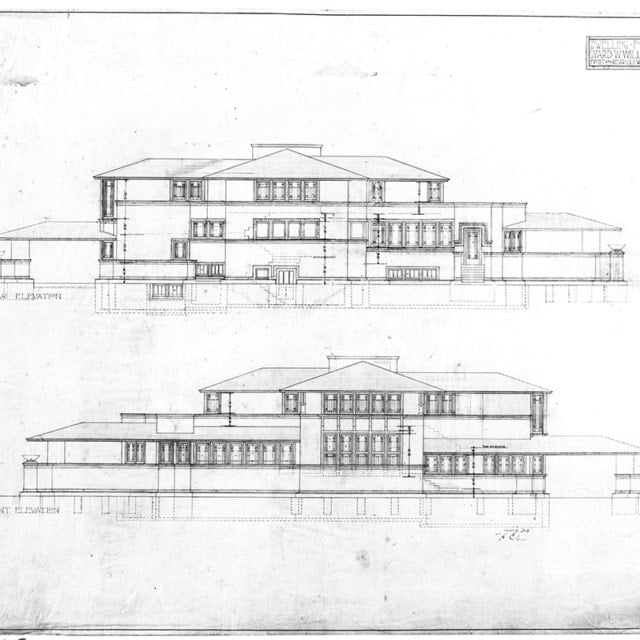
His main goal was to create an indigenous American architecture, and over the next sixteen years, he set standards for what became known as the Prairie Style. "These houses reflected the long, low horizontal prairie on which they sat with low-pitched roofs, deep overhangs, no attics or basements, and generally long rows of casement windows that further emphasized the horizontal theme."


Later on, he wrote a couple books on his philosophy of integrating country with urban/city and founded an architectural school at Taliesin, the “Taliesin Fellowship,” an apprenticeship program to provide a total learning environment, integrating not only architecture and construction, but also farming, gardening, and cooking, and the study of nature, music, art, and dance. During the Great Depression, he worked on affordable housing, which then became known as Usonian architecture. These homes would reflect both economic realities and social trends (simplified, yet beautiful environment and affordable.)
Notice how these new residences will tend to be more "boxy" than the previous prairie houses. Wright focused on Usonian structures for most of the rest of his career.

His most famous works are Falling Water (residential house) and the Guggenheim Museum in NYC:


While both serve very different purposes and reside in vastly different environments, Wright's approach and "organic architecture" style are obvious. His constant uses of "layering" gives his buildings an organic quality---allowing Falling Water to perfectly complement its setting, as if the house should have been there the entire time, and bestowing the Guggenheim Museum with an eerie "concrete jungle" feel as it brings art into the urban landscape. And that is what I find the most compelling about his work. Separately, I don't like the techniques he uses (who would want small windows in their house?), but when Wright brings them all together and unites it with the environment, it remarkably works out spectacularly.

As a last note, I also want to include some of his glass work. They were often in the residences he designed and these stained glass windows really helped make his designs iconic:

Sources:
  • http://franklloydwright.org/frank-lloyd-wright/
  • http://www.wrightontheweb.net/


Roy Lichtenstein (1923-1997) – Ali Goldsmith

Roy Lichtenstein was one of the key players in the rise of American Pop Art. While regarded by some as one of the most innovative artists of his time, others criticized his “comic-strip” inspired work as unoriginal and banal. In my opinion, Lichtenstein's work is a beautiful but literal reflection of contemporary culture, which is meant to be both thought provoking and controversial.


Lichtenstein was born in New York City and was raised on Manhattan’s Upper West Side. As the son of a successful real estate developer, Lichtenstein was able to explore his interest in art at an early age and began taking classes at Parsons School of Design and studying under realist painter Reginald Marsh in his teens. After graduating from high school he attended Ohio State University, but his studies were interrupted in 1943 when he was drafted and sent to Europe during World War II. After his service, he returned to Ohio to finish his undergraduate and master’s degrees in fine arts.


While working various odd jobs as a window display designer and commercial art instructor, Lichtenstein began exhibiting his work in galleries in New York City in Cleveland. His early paintings and prints were inspired by medieval knights, castles and maidens with a satirical twist. He then moved onto a Cubist series that paid homage to 19th century cowboys and Indians.

It wasn’t until his 40s that Lichtenstein developed his signature style. In the 1960s, while teaching at Rutgers University, he began to create work that both mocked the success of Abstract Expressionist artists such as Jackson Pollock and commented on American popular culture. His newer work drew inspiration from comic strips and illustrations from advertisements. To create his paintings, Lichtenstein cropped parts of comics and projected the image onto a canvas. From there, he meticulously painted the images, adding his own color and message. He wanted the paint to look mechanically applied, again mocking commercial art and advertising. The almost impersonal-looking stencil process of Lichtenstein was a significant departure from that of his contemporaries. Instead of the abstract and emotional techniques of Pollock, Kooning and Rothko, Lichtenstein's work was literal, formulaic and satirical. These tongue-in-cheek parodies of the art world and culture eventually became his most well known works.
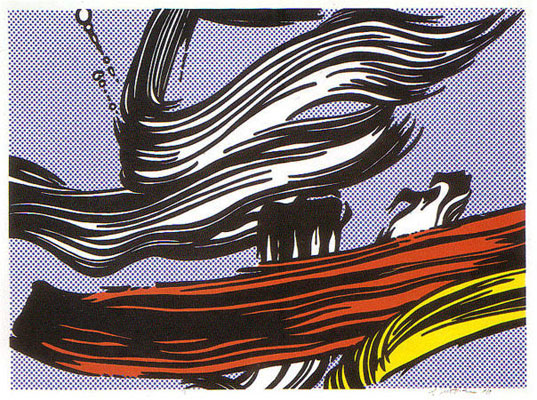
Image result for brushstrokes lichtenstein
Roy Lichtenstein, Brushstrokes, 1967, color screenprint on white wove paper.


“Brushstrokes” parodied the methods of Jackson Pollock and mocked the supposed importance of the brushstroke in Abstract Expressionism.
Image result for lichtenstein 1960s
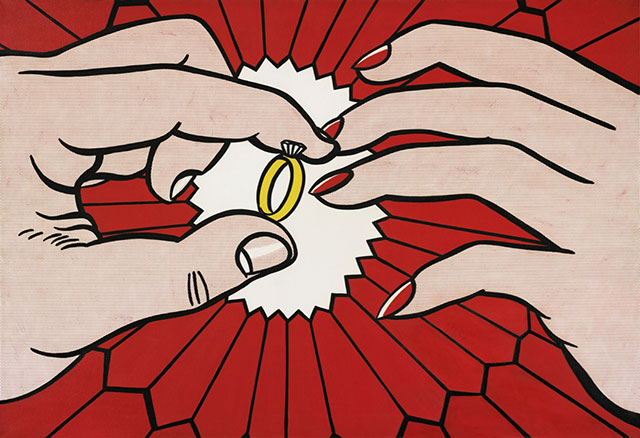
Roy Lichtenstein, The Ring (Engagement), 1962, oil on canvas.


Lichtenstein painted “The Ring (Engagement) as he was ending his first marriage and beginning a new love affair. The hovering ring is meant to symbolize the unattainable, uncertain and fantastical aspects of love and commitment.

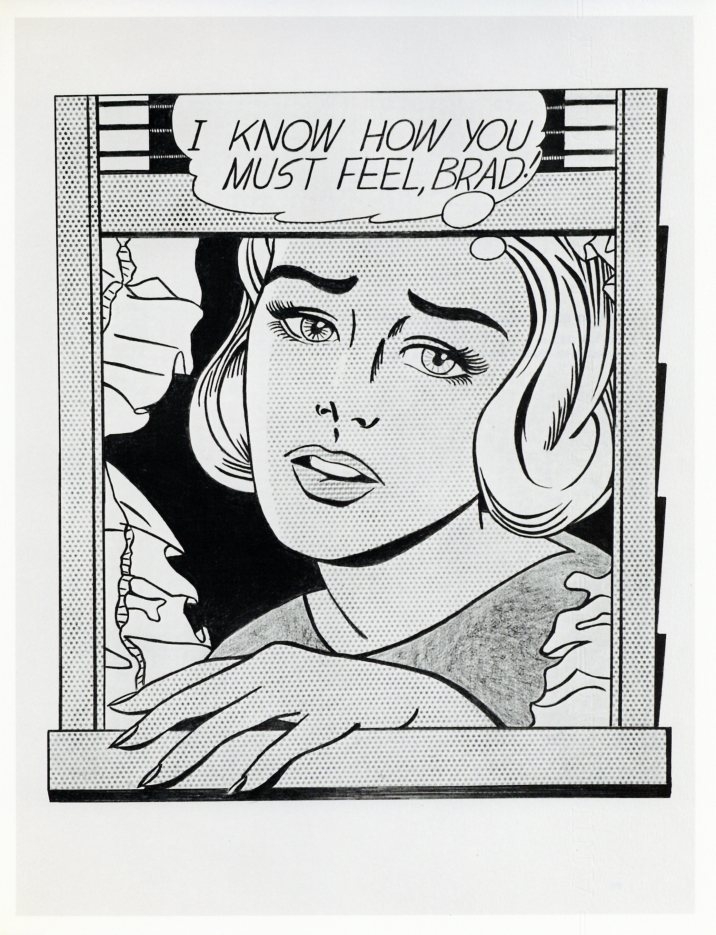
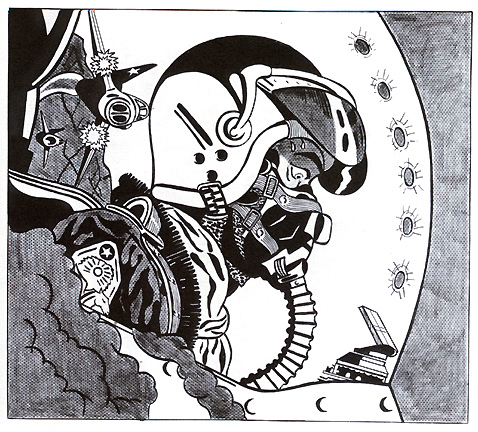
Although he is primarily known for the high-impact, brightly colored paintings mentioned above, Lichtenstein also excelled in other mediums. Around the same time he was creating iconic works such as “Drowning Girl” and “Popeye,” Lichtenstein also explored drawing with pencil. These works are stylistically similar to his other comic-like paintings with crisp lines and Ben-Day dots creating an illusion of shading and depth.
Image result for i know how you must feel brad
Roy Lichtenstein, I Know How You Must Feel, Brad!, 1963, graphite pencil, pochoir, and lithographic rubbing crayon.
Image result for jet pilot lichtenstein
Roy Lichtenstein, Jet Pilot, 1962, graphite pencil.


I’m especially drawn to Lichtenstein’s pencil drawings because of the work we’ve done in this course so far. Instead of using traditional shading, Lichtenstein uses closely spaced dots and varying line weights to create depth. Not only does this technique make his images pop, it also gives it a unique texture. The range of color Lichtenstein is able to create with just a pencil is equally impressive, with some areas a very light grey and others solid black.

Furthermore, I enjoy the tongue-in-cheek commentary on society, the art world and consumerism that is present in each of his works. His subversive concept of creating a unique body of work from mass-produced images is incredibly compelling. Although the creativity of his work, along with that of other leaders of the Pop Culture Movement, was and still is heavily debated, I believe that Lichtenstein struck the perfect balance between fine art and entertainment.


References:


Rondeau, James. Edlis/Neeson Collection: the Art Institute of Chicago. Chicago, Art Institute of Chicago, 2016.


“Roy Lichtenstein.” Gagosian, www.gagosian.com/artists/roy-lichtenstein/artist-exhibitions. Accessed 21 Feb. 2017.


“Roy Lichtenstein Biography, Art, and Analysis of Works.” The Art Story, www.theartstory.org/artist-lichtenstein-roy.htm. Accessed 21 Feb. 2017.


“BIOGRAPHY.” Roy Lichtenstein Foundation, lichtensteinfoundation.org/biography/. Accessed 21 Feb. 2017.


“Roy Lichtenstein.” Biography.com, A&E Networks Television, 2 Apr. 2014, www.biography.com/people/roy-lichtenstein-9381678#later-career. Accessed 21 Feb. 2017.