Wednesday, December 5, 2012

Riley Pratt

M.C. Escher

I decided to do my post on M.C. Escher, a famous Dutch graphic artist from the 1900's.  His most notable drawings, lithographs, and woodcuts play with impossible spaces and mind-bending perspectives.  He had a unique ability not only to visualize theoretical shapes and perspectives, but also to turn these ideas into incredible works of art.  He did wonderful realistic pieces as well, inspired by his travel throughout Europe.

Growing up, he had numerous health issues that interfered with his ability to perform in school.  He recognized his artistic abilities, but even struggled in architecture school.  His career took off when he discovered graphic design and his pieces would become famous throughout the world.


Relativity, 1953


Belvedere, 1958


Waterfall, 1961

The amazing thing about Escher's works was his ability to execute the illusions he imagined with perspective and shading.  In Relativity, the viewer is drawn into different areas that only seem real when your eyes remain within a confined space.  As you leave the space, you find yourself reorienting your point of view so that the objects make sense as three dimensional objects.  Eventually, it's possible to find your way back to the same place even though you were following a path only up or down the stairs.  Belvedere manages to connect two identical rectangular platforms, oriented in opposite directions, as if they were stacked normally.  In Waterfall, Escher amazingly depicts a waterfall that appears to fall two stories, but actually starts at the same level as the wheel it's turning.  The connection of the support beams and their shading is crucial to pulling off the illusion.

Escher's work makes you think about our perception of reality.  As you try to make sense of the space he's created, you might end up in the same place you began without realizing you were going there.  There's a lot to learn from his ability to use shading to make the surreal seem so real at first glance.  It's possible to imagine yourself standing in one place in the world he created, but reality fades away as you move throughout the space or try to make sense of it as a whole. 

Sources:

Hofstadter, Douglas R. M.C. Escher: Visions of Symmetry. 2nd ed. New York City: Abrams Books, 2003. Print.

The M.C. Escher Company B.V. “M.C. Escher: The Official Website.”http://www.mcescher.com/

Eliza Strong's Thoughts on Drawing

I started drawing at a very young age.  It was and is an extraordinary outlet for stress and creativity, and exercises a part of my brain seldom used in painfully copious amounts of problem sets and textbook readings (science majors beware- organs unused may atrophy). In the same way that reading can transport one to another world, another life, drawing can pull the artist into deeper recesses of his own mind, wherein abide landscapes, faces and strange objects yet unrealized in the natural world--only waiting to be released with a pencil's stroke.

Art can do what the written word cannot. It can immediately, without any effort but a glance, show you something that isn't there, perhaps not nearby, perhaps not even extant. It has the power to transmit the imagination of the artist directly to that of the viewer. What is more, the viewer sees it with all of his or her various life experiences and history, projecting this onto the work of art (perhaps even thinking, "They must have known just what I felt when x happened," even if the artist had his own entirely different experience in mind; for a moment, the viewer felt related to).  Works of art have this amazing power to connect people through space and time, reminding us of shared human experiences or helping us to understand ones totally foreign to us. 

I will never create masterpieces at which onlookers will marvel a few hundred years down the road (I'm looking at you, Van Eyck, Raphael, Titian--what's your secret?). Being an artist is simply not my calling in life, but I love drawing all the same.  I will never draw a perfectly formed human figure, or a face with an expression evoking pathos and emotion.  But I can try to express the world through my eyes, or put what's in my brain on paper, and frankly, that's enough for me. The value in art is and always has been for the creator himself.  Artists do not do their work for others; they do it for themselves, because they have a unique way of expressing the world according to them, and want to put it out there for others to see.  It is a brave profession, surely full of many obstacles, but it is one without which the human race would not be what it is.  Humans can envision and transcribe imagined things far beyond the ability of any other known animal, allowing us to have goals, empathy for the experiences of others, an appreciate for beauty.  

I am extremely grateful tor the opportunity to rekindle my interest in and love for art. It has been a fantastic release for me in a semester more filled with stress than I could have imagined. Coming to class or doing the homework forces me to sit down and just draw, not thinking about organic chemistry reactions nor enzymes nor verb conjugations.  For a few hours, my mind is free, only focusing on putting what I see onto paper.  After hours of careful labor, a piece of artwork-tangible, finished- is in my hands. No such satisfaction is possible in nearly any academic endeavor, nor so dramatically hinged upon amount of time spent doing the work.  I can study organic chemistry for twelve hours straight in the library and still not do any better on an exam, but if I spend twelve hours drawing, my work will come out better than if I had spent only one.  This is a passion I hope will follow and serve me throughout the rest of my lifetime, whether I (unimaginably) become the next Mary Cassatt, or if I stick to doodling on napkins at coffeeshops, avoiding doing "real" work, or simply stand and stare in admiration at the work of someone who followed their dreams and won. 

Riley Pratt

Thoughts on Drawing:

I've loved to draw for as long as I can remember.  When I was little, I'd flip through Sports Illustrated for Kids and find pictures of Vince Carter, Allen Iverson, Jerry Rice, Ricky Williams and other athletes and lose myself in a drawing.  I used to submit pictures I drew to the weekly contests that would end up in the magazine (my drawings never got chosen, though, and I was pretty jealous when I flipped through and found my friend's drawing of Randy Moss with a third arm coming out of his back stiff-arming a defender).  I still have a bunch of drawings from middle school art classes and even older drawings that remind me of when I discovered art.  I was always amazed at how much time passed when I really got into it, and the same is definitely true for the drawings we've done in this class.

I started drawing cartoons during classes when I was little and I have a dry-erase board in my room that I draw characters on, and a lot of them are different versions of the same characters I started drawing back in elementary school.  I was disappointed at first that this class didn't have a cartoon or fantasy component (except for the last drawing), but having taken the class now I'm glad it didn't.  I had never drawn still life before--I had only drawn from pictures and my imagination--and I discovered a whole new world of drawing.  I often find myself looking at scenery in a different way now; I see negative space, shading, and details that I wouldn't have considered before I tried this class.  On campus this is especially true - I have a newfound appreciation for the architecture I already loved.  It's funny to look up at the intricacies of the gothic buildings and thinking about how it would look in a drawing (or how hard it would be to draw).  I learned a lot about shading, and the subtractive and negative space drawings taught me new techniques and ways of thinking about how to approach a drawing.  In addition, I had never done drawings as big as the ones we did and it helped me visualize space and depth in a new way.  I've never been one to try a rough draft (even in writing) and I tend to just jump right into a new project, but the study drawings we've done have been really helpful in planning out the spacing and visualizing the whole piece.

I always enjoy sitting down to work on our projects and it's a nice way to relax and free myself of the structure of other classes.  It's nice to throw on some music or just sit around with my friends and get into a drawing - distractions might slow me down some, but they never affect the quality of the drawing and I feel like I'm just having fun, not working for a class.  I didn't appreciate at first how long it takes to make an 18x24 drawing, though, and I think I've spent more time working on this class than any of my others.  It can be stressful knowing that I have to work on a paper for a few hours, study for a quiz, then spend hours finishing up our projects.  I can't make myself work quickly because I get really into it when I start - moving forward, I'll know to budget more time for art projects if I decide to take any other classes.  I loved this class, though, and it's definitely made me consider either an VMS minor or at least taking other classes for fun/to learn new techniques, and I'll definitely apply some of the things we've learned to drawings I do for fun the rest of my life. 

Thoughts on Drawing - Eleanor Kenimer


I started to draw at a young age because my mom was an art teacher and arts education was highly stressed at the small progressive elementary school I went to.  Scribbled drawings and paintings by my brother and I from when I was just a toddler still cover the walls of my house.  As I grew older I continued to like art, but the presence of art in my life grew slimmer and slimmer.  In middle school I took photography, which I really loved and in high school I took a few general art classes, but didn't like the program at the giant high school I went to.

My interests are really quite varied and going in to college I knew that I wanted to study science, but I was hoping to get a chance to take some various classes in my other interests.  As a freshman, I wasn't able to, but finally this semester I decided to take drawing.  I wanted to take at least one art class during my time at Duke.  I knew that I wasn't going to be able to take many because I am studying something so different, but drawing is something I have always been passionate about and even though I might not be the best at it and it is definitely not the career path for me, I wouldn't want to lose it completely.

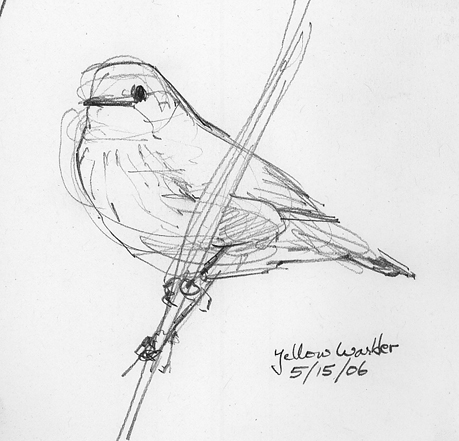
I love drawing animals, and especially birds.  I hope that maybe some day I can combine my interests in nature and science with my passion for drawing.  Scientific drawings and sketches have a simplistic beauty that I really love.  I love to look at the drawings in field guides especially bird guides because despite the fact that they are supposed to just look as much like the bird as possible, they definitely have an artistic quality to them.

I also like drawing as a stress reliever, which was kind of the part of this class that made it less than perfect.  I don't like having a deadline for drawing.  I know that that's obviously important as part of a graded class, but drawing seems like something that should be done on your own time, just whenever you are inspired or moved to do so.  Some of my favorite drawings I did this semester were in my sketchbook because I didn't really have to do them at a certain time.  I would take my sketchbook around and pull it out at a random time when I saw something cool or thought of a bird I wanted to draw and would look it up on the internet while eating lunch or on a study break.  I even took my sketchbook on a rock climbing trip and drew a picture of my boyfriend climbing.  But, the big drawings were often more stress inducing than stress relieving. 

Overall, I am glad I took the time in my semester to take an art class.  I'm glad that I was able to do something other than science in my time at Duke.  Hopefully I'll have enough room in my schedule in the future to take something else (maybe photography or painting), but even if I don't at least I got to this semester!

Thoughts on Drawing - Amanda Giddon


            I have some experience drawing, but prior to this class I had no experience drawing still lifes. Freshman year my creativity was channeled into doodling, and my artistic pursuits were limited to the margins of notebooks and the pockets of folders. Drawing still lifes has altered my view of scenery, landscape, and visual compositions in general.  Specifically, the still life practice has caused me to naturally identify shapes formed in negative space, and prompted me to consider proportions of objects in relation to one another.
            In addition to enhancing my modes of looking, drawing has also provided me a means of stress relief.  Wedged in with scientific assignments, drawing exercises my rights brain and provides me with cerebral endorphins. The non-exclusivity of drawing is liberating. I can draw while I listen to music, talk with friends, or watch a movie. In my academic day dominated by tests of attention and complete focus, drawing is a breath of fresh air. However, not all of my drawing pursuits have been stress-free.  When midterms are approaching or final papers are looming, the 6+hour commitment to a piece can be overwhelming.  This split personality of drawing, and how it can act as a stress-reliever or stress-inducer, causes my feelings about drawing to vary. It is a turbulent relationship, but a rewarding one. The feeling achieved when finishing a piece is without fail enthralling. Spraying Fixatif on a finished charcoal 18 x 24 had become the most triumphant of victories. In addition to improving my drawing abilities, this class has provided me with a sense of balance, and caused me to employ time management skills.
            Drawing this semester has also made me realize my strong suits and shortfalls when constructing an image, which is definitely indicative of a successful class. I am far more confident in my abilities to invent an intriguing composition, (it’s all about diagonals!), and am still unsure about creating realistic planes in regard to perspective. Walking away with a confidence boost and idea of where I can improve gives me the courage to continue drawing and the humility to keep trying to improve and learn about drawing techniques. For this, I am incredibly grateful, and am beyond excited to continue exercising my creativity in a comic’s class next semester.
            Since I was young, I have always wanted to write and illustrate a children’s book. Though I keep this goal in my back pocket, I have accepted the fact that if I don’t achieve this, I will not be letting myself down. (Though my 5th grade self might tell you otherwise.) However, it remains important to me to hold on to art, hold on to my creativity, and nurture it. I have found at time that I am concerned about maintaining this relationship. However, drawing at Duke has alleviated my anxieties about losing my connection with art that began so long ago. Even if I am not practicing art into old age, I hope to always look at art with an appreciation and perspective that not every other person possesses. I trust that I can accomplish this, especially with the support of a great art department at Duke, which I have had the pleasure to experience this fall. Thank you!


Fernando Jin - Why I Enjoy Drawing


Why I Enjoy Drawing

Fernando Jin


A lot of people like drawing, no matter it is kind of professional like the sketch class I am taking now, or it is just some random doodles we draw on our textbooks. So why do I love drawing? Is it something like an instinct, or is it something I have unconsciously developed as I am growing up?

I would say it involves both.

On the one hand, it is something like a human’s instinct. As we all know, before words came into being, one way ancient people record things and communicate with each other is through hieroglyph. Although nowadays we have very developed oral and written languages, drawing is still an interesting way to communicate with each other. And also, say, when an American, a Swedish, and a Pacific Islander meet, drawing can be a very efficient way for them to communicate with each other, while apparently they cannot do this without translators.


Also, it has something to do with our physical structure, especially our brain. As we all know, human brain mainly has two areas: left brain and right brain. Left brain mainly handles logic, while right brain mainly handles abstract things. As a result, human beings naturally like drawing as there is a need for our left brain to develop. Through drawing, we can develop our creativity, and drawing is always a great source of inspiration.


However, a phenomenon that we all probably can notice that most kids love drawing, while only a very small portion of adults like drawing. This leads to an obvious fact – one’s instinct is not sufficient to sustain one’s interest in drawing. So what is the other necessary part?

I would say it is goals. Some people worship those great artists and hope they can be as good as them sometime in the future. Some people draw because drawing is there work and they way they make a living.

For me, I enjoy drawing because of pure interest. To me, drawing is really beautiful and I really revel in this kind of beauty. I can get a lot of joys out of drawing. Drawing is relaxing and full of inspiration. At the same time, I also want to be better skilled at drawing, so I can better capture the beauty of life.

That’s why I love drawing.


Monday, December 3, 2012

Drawing


To explain the events of my semester long sashay into the arts, I will use a series of quotes from some of my favorite artists.

To quote the artist occupying the latest exhibit in the Nasher (Matisse) “Creativity takes courage”. As someone who really knew nothing of drawing or art going into this class I can promise you that I was blindsided by the amount of courage it actually took to put a pencil to a piece of paper and draw. I’m pretty sure that in the beginning it took me at least three times the amount of time it took everyone else to finish a drawing. I finally realized that it was because I spent so much time watching what everyone else was doing or nervously planning that first stroke in my head. I still struggle with really committing my pencil to the paper but I think I have improved as it doesn't take me three times as long anymore. Maybe just twice as long…

To quote Edgar Degas, “painting is easy when you don’t know how, but very difficult when you do.” I believe this characterizes the middle few weeks of my drawing experience. As I begin to improve in my drawing I felt as though there was a brief period of time when the drawing actually got harder. As we began to learn about perspective and lines it became even harder for me to make that initial stroke with the pencil.

A turning point came for me about a month ago with a drawing I did of a bridge in the garden. For some reason I was able to spend a little more time on this piece and something just clicked. I felt as though I blinked and my drawing didn't look cartoonish or scribbled anymore – it looked like the drawings my peers had been turning in all semester. Although this piece and the following ones weren't perfect, I was able to find solace in a quote I had always known as Salvador Dali’s; “Have no fear of perfection, you’ll never reach it”.

In the last week of my drawing class I feel as though I have gotten out of this class exactly what I didn't come for – a challenge. I have learned not only so much about drawing but also a lot about myself. This drawing class might have been the most challenging class I have ever taken at Duke. When I thought of drawing or any other creative endeavor I used to explain to friends that my brain just didn't work that way, however now I know that is just not the case. I hope that I continue to drawing and learning from the way my skills become better with every stroke. My inspiration to continue drawing comes from a quote by Paul Valéry who said, “an artist never really finishes his work; he merely abandons it.” I now know my adventure into the world of art is not over- my drawings have left so much to be finished.