Sunday, November 24, 2019

On Being an Artist at Duke - Juliana Arbelaez

Until this semester, I had never seriously integrated art into my life at Duke. Beyond making my own dorm art or being asked to paint coolers for friends in the spring, I rarely dedicated time to seriously practicing art. If discussing art in a liberal sense, my dedication to film photography as a means to document my college years could be counted as practicing art. In high school, I took IB Visual Arts HL. Coming to college, I switched from dedicating a couple hours a day to art to almost none in just a summer. I think this is because of the overarching pressure at Duke to focus on “academic” or career-oriented pursuits instead of something that is often written off as extracurricular.

In the general sense, I don’t think that art is an important part of the Duke experience. I don’t think labs or late nights in Perkins or even the basketball team are an important part of the Duke experience either. Every individual at this school has a different experience and thus has factors with differing important to that experience. In saying this, I admit that can be an essential part of an individual’s Duke experience. It has yet to become part of mine, not because of lack of significance, but simply because I have chosen to dedicate the time that has constituted my experience thus far to other things. 

I do think that Duke has a community of artists if you desire to become a part of it. We have incredible spaces to practice different art forms like the Arts Annex, the Ruby, and Smith. Although the artistic community may seem quieter than some of the other communities on Duke’s campus, I don’t think this is because of its lack of existence or vibrance. I would encourage all students to take an art class at Duke, regardless of previous experience or desire to pursue art further. Whether it be a drawing, photography, or dance course, I think taking the time to grow in an area that may be unfamiliar or challenge a different part of yourself is beneficial and a necessary part of the college experience. 

Saturday, November 23, 2019

To be an Artist at Duke

Art is what keeps me grounded. At Duke and other
Duke-adjacent schools, it isn’t difficult to become
consumed with grades and expectations and extracurriculars
and the all-too-familiar feeling of not doing enough.
Creating has become my solace. In the past, I found myself
perceiving art as a “breaktime” activity, something I’d do if
I got around to it--so I never did. Living this way--assignment
to assignment--is unsustainable and unhealthy. About halfway
through last year, I began to prioritize balance, carving out
time to create just as I carved out the time to study. 
Although art may not be put forth as a defining feature of
Duke, the campus is full of artists; it’s just a matter of
seeking out community with them. One’s first thought may
be to seek out this community by flocking to art-related
extracurriculars. In fact, when I arrived on campus, this is
how I assumed I should go about it. And although this is a
valid approach, I’ve found more community with artists
outside of extracurriculars--in happenstance revelations that
I have a passion in common with someone else. Many of
Duke’s artists are quiet creatives with a multitude of
different interests; fishing out who is also an artist has been
a really fulfilling experience for me. 

I think that art can be an important part of the Duke experience, if
one chooses to seek it out. Duke has so many artistic resources,
from the Ruby to the Arts Annex to film screenings, etc.
Experiencing art can be a huge source of growth; it exposes you
to different cultures, viewpoints, new ways of looking at things:
a time for reflection. College is a time to experience new ideas
and broaden your worldview. Art can help attain this. I believe
that incorporating art, whether it be as the creator or as the
viewer, provides the individual with a much fuller experience.


Monday, September 30, 2019

Contemporary Latin American Art

Throughout the second half of the 20th and continuing into the 21st century, contemporary art has expanded upon traditional perceptions of art by placing into conversation the developments and challenges of the present day. Rather than focusing more on particular techniques or a singular theme, it is "distinguished by the very lack of a uniform organizing principle, ideology, or -ism." This differs greatly from other art periods and movements such as Impressionism, which analyzes our world and perception through moments of light and color rather than focusing on pure realism. Contemporary art has evolved to instead reflect more broadly on a variety of social issues, including but not limited to identity politics, globalization, migration, technology, and critiques of present institutional and political systems.
Similarly,  Latin American artists have taken part in the contemporary art movement by creating art that expanded upon previous conceptions of Latin American art and explored the socio-political dilemmas of the day and age. Historically, Latin American art has often been presented as colorful, folkloric, and rustic without the type of intellectual and political depth afforded to artwork created by American and Western counterparts.  Latin America thus was often promoted with a “frozen image”, one that did not accurately represent the developments in the region. Artistic institutions promoted this image by encouraging less controversial visual art that “imagined Latin America as detached from its artists, regional, and international politics, and the Latin American community in the United States.” However, contemporary Latin American artists have worked to expand upon these perceptions by creating work that critiqued the social and political issues of the time. Some of the most dominant themes of the last 30 years have been the rise of Conceptual, Minimalist, and Performance art with critiques of Western imperialism, neo-colonialism, globalization, and military dictatorships in Latin America. 
 For instance, pop artist Antonio Caro painted his work Colombia Coca-Cola in 1976, which presents the name of the artist’s country in the iconic Coca-Cola script. Here the superimposition of nation and logo points was Caro’s critique of the history of U.S. imperialism in the region and to the “blurring” of the line between consumers and producers.  

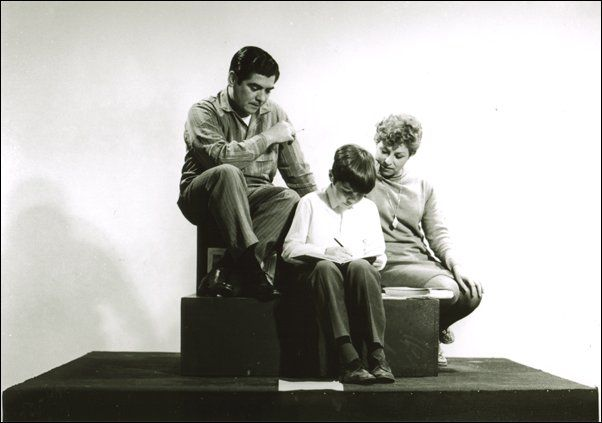
Other Latin American artists also used their work to critique the political situations in their home countries. For instance, Oscar Bony, created art to comment on the disastrous economic policies in his home country of Argentina.  His piece, La Familia Obrera (The Working Class Family), was controversial when first presented at the Experiences 68 exhibition at the Instituto Torcuato Di Tella in Buenos Aires. Bony utilized the exhibition budget to pay a working class family to sit on a plinth in the gallery for eight hours a day while recorded sounds of their home life played in the background. Through this piece, Bony strove to  illustrate just how low wages were considering that the family’s father in the exhibition made twice as much participating in the exhibition than at his job as a die-caster.
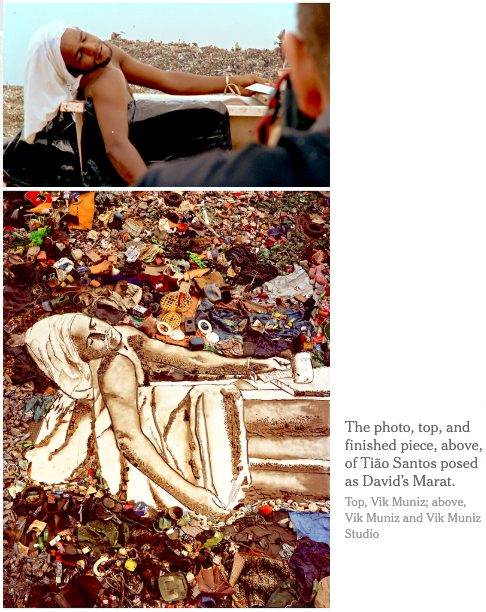
Contemporary Latin American artists have also utilized the power of modern day media to multiply the impact of their art. Brazilian photographer Vik Muniz has gathered notoriety internationally through the use of photography, mixed-media, and film to comment on the effects of globalization and economic inequality.  Some of his best known work repurposed everyday materials to make intricate and heavily layered recreations of canonical masterpieces. From my perspective, one of his most impactful works was a project in which he photographed trash-pickers as figures from emblematic paintings, such as Jacques-Louis David’s Neoclassical Death of Marat, and then recreated the photographs in large-scale arrangements of trash. The project was preserved in the 2010 documentary Waste Land, in an attempt to raise awareness for urban poverty. In line with the themes of many modern day contemporary artists, Muniz explained the work as a “step away from the realm of fine art,” and an effort to “change the lives of people with the same materials they deal with every day.”

  
Bibliography

Abrams, Loney, and Loney Abrams. “The Other Art History: The Badass Latin American Artists Who Made '70s Conceptualism Politically Hardcore.” Artspace, September 20, 2018. 

“Colombia Coca-Cola · Blanton Museum of Art Collections.” Omeka RSS, utw10658.utweb.utexas.edu/items/show/2944.

Contemporary Art in Context. (2016). Retrieved December 11, 2016

Cotter, Holland. “Review: 'Transmissions' at MoMA Explores an Era When Art Upended Tradition.”

Kino, Carol. “Where Art Meets Trash and Transforms Life.” The New York Times, The New York Times, 21 Oct. 2010, www.nytimes.com/2010/10/24/arts/design/24muniz.html.

Ramirez, Mari Carmen. “Beyond ‘The Fantastic’: Framing Identity in U. S. Exhibitions of Latin American Art.” Art Journal, vol. 51, no. 4, 1992, p. 60., doi:10.2307/777286.

Robertson, J., & McDaniel, C. (2012). Themes of Contemporary Art: Visual Art after 1980 (3rd ed.). Oxford: Oxford University Press.

“Vik Muniz.” 501 Artworks, Bio & Shows on Artsy, www.artsy.net/artist/vik-muniz.

Contemporary Art and Social Narration-- Ali Rosenbaum

Contemporary Art and Social Narration
To me, contemporary art is fickle. Most of the time, at a museum I am left scratching my head saying, “how would anyone ever consider a simple, wooden chair art?” But every so often, I feel a connection, a feeling deep down almost as if I relate to painting, or a sketch. To me, art is all about what a person can say without using words. Contemporary art just specifies a time period. And the trends of today’s time period range everywhere from instillation art exhibits to pop-culture artwork, centered around brand names. For example, painter Oliver Gal has built an empire around selling paintings and prints that focus on brands like Chanel, Gucci, Hermés, etc. The subjects of her paintings are light and fun, including puppies wearing sunglasses; designer fire extinguishers; or pricey handbags. Gal’s style is fun and relatable to all ages which I believe really encompasses contemporary artwork. Sometimes, I feel the subject matter of Gal’s artwork is a bit superficial, however, I admire her use of color and pop culture.
(Oliver Gal)


My personal work centers around more observational drawings. Often times I draw things that just catch my eye; typically “forgotten objects.” For example, rotary phones or old cameras. Recently though, I have been experimenting with more pop culture artwork. I try and push myself to combine some of the trends from above with my go to styes. The intersection of the two are both mentally interesting and visually stimulating to me. Contemporary art is geared towards recognition; People consider the insinuations of a piece of artwork now as opposed to simply judging just how realistic a face can be drawn. The lasting impressions a singular composition can have on a person are so powerful. 
(Pez)(Pez)(Pez)

I think one contemporary artist who I admire and relate to incredibly is the Spanish sketch artist Pez. This artist focuses on social themes, in an eye-catching way. Similar to my artwork, Pez typically centers his artwork around one central focal point. His sketches are typically plays on every day objects, but with a modern twist. The meaningful implications of the drawings tell a narrative… they imply social injustice, environmental detriment, and other pressing societal issues. 

(Pez)(Pez)


Sources:


Juliana Arbelaez - Humor in Art

Humor in Contemporary Art


For centuries, art was denoted as creative expressions of serious concepts, people, or events in time. More recently, what is considered to be art has greatly expanded and the required craftsmanship element of art has lessened, giving rise to a number of classically untrained individuals making huge imprints on the artistic world. Specifically, the established status or importance of subject for art to be considered “worthy” has almost vanished allowing artists to capture images and themes that span the emotional spectrum.


Humor is typically conveyed verbally, through established comedians or just between friends, but has seen a rise in usage in the visual world. Comics may be viewed as the original form of visual humor although they heavily depend on the dialogue between characters to convey their message. Humor is important to contemporary art because it can be used to alleviate the tension that certain pieces create or shed light on the ridiculousness of certain modern problems. Just as a “joke can resolve (or cause) the most difficult situation to a consideration of how satire can sway public/political opinion, humor, when used correctly and strategically, allows an artist to effectively communicate with their audience in ways that are both immediate and subtle” (Molon). 
"Brilliant Disguise" (Zzep)

"Capitalism" (Salles)
"Sex" (Salles)
One of my favorite contemporary works that relies on humor to convey it’s deeper meaning is a piece entitled “No Shoes, No Shirt, You’re Probably Rich” by Alejandro Diaz. The piece mimics the common “No shoes, no shirt, no service” signs that are seen in the windows of many businesses but alters the well-known phrase to play on income inequality. Although the real sign is perceived to mandate a minimum level of formality or dress, Diaz’s piece draws attention to the sense of entitlement or “above-the-law”-ness that wealthy citizens may feel or display. Instead of a long essay about privilege, Diaz succinctly and lightly touches on the issue and lets the viewer infer the deeper meaning while also tipping their hat to his crafty, dry, and subtle humor.
"No Shoes, No Shirt, You're Probably Rich" (2015)

Works Cited

Diaz, Alejandro. No Shoes, No Shirt, You’re Probably Rich. Accessed September 30, 2019. https://www.artspace.com/alejandro-diaz/no-shoes-no-shirt-youre-probably-rich-1.

Hsu, James. “Illustrated Humor and Social Commentary, Eduardo Salles Art Gallery.” Third Monk(blog), October 10, 2013. http://thirdmonk.net/knowledge/illustrated-humor-social-commentary-eduardo-salles-art-gallery.html.

Molton, Dominic. “Anything for a Laugh: Humor in Contemporary Art | Art+Culture Projects | Artsy.” Accessed September 30, 2019. https://www.artsy.net/show/art-plus-culture-project-anything-for-a-laugh-humor-in-contemporary-art.

Body Art In a Contemporary Landscape

Body art is the contemporary art form of decorating or changing the human body with ephemeral paintings, permanent tattoos, scarificationbranding, implantsshaping. These forms of body modification often completed as as part of a cultural tradition, an appreciation for art, a method of beautification, or a study of the structure and limits of the human body.

Scarification in Australian and African
Aboriginal cultures served as a method
of beautification and testing fitness.
Body art has roots dating back to the prehistoric era. Dr. Enid Schildkrout, who curated the American Museum of Natural History's exhibition “Body Art: Marks of Identity,” has placed the significance of body art in history as “a way of signalizing an individual’s place in society, marking a special moment, celebrating a transition in life or simply following a fashion.” In the earliest cultures, humans had always been changing and molding the body through tattooing, painting, mutilation as part of cultural rites of passage. Moving into the 16th century, women of Europe began body modifications using corsets for beautification. Use of corsets have waxed and waned, but is historically an extremely well-known form of body art.

It wasn't until around the 1950s that body art experienced a resurgence linked with the cultural and societal expectations surrounding one's roles and responsibilities in the modern era. Increasingly, body art has had roles in performance art, where an artist uses the human body to convey their message. Common messages have included dissatisfaction with hyper-consumerism, exploration into technological or virtual bodies, or testing limits of stressors on the body including extreme body mutilation.

One notable form of body art that has caught my interest and shock is the Brutal Black tattoo project, which, as Fareed Kaviani puts it, "prioritizing pain over aesthetic". Whereas a tattoo session involves mitigating a person's pain, a Brutal Black tattoo session does not accommodate for respite from the pain of getting tattooed, and instead instructs the recipient to embrace the pain of being tattooed as quickly and brutally as an avenue for "ritual and rebirth" through tattooing. As one of the artists Phillip 3Kreuze states, "In this project, there's no compassion, no scruples, no sense of empathy."

This form of modern art reminds a lot of the historical information I have read regarding body mutilation. Brutal Black calls back to a time when body art was valued for its pain rather than for its beautification in the way it tested human limits and allowed the recipient to experience a form of euphoria. To me, body art is representative of how one artistic movement can often have such disparate components, much in the way that art can so starkly juxtapose an appreciation of beauty and a ritual of pain.

Citations:
The Black Effect: Black Expression in White Spaces 

By Alexis Joseph

            
“Protest is telling the truth in public. Sometimes protest is telling the truth to a public that isn’t quite ready to hear it. Protest is, in its own way, a storytelling. We use our bodies, our words, our art, and our sounds to tell the truth about the pain we endure..” – Deray Mckesson.

             When learning about the history of art, I was shown images of the wealthy white men and women painted by white men. When learning the history of the United States, I was taught about the white landowners from textbooks written by white men. It wasn’t until I was older, that I realized I was blatantly unaware of black authors, black artists, black scholars, or even noteworthy people of color in general.
          
   After researching contemporary art and artist, I again witnessed the absence of black artists and faces. The essence of contemporary art is the unconventional way of conveying culture, community, and the current life surrounding us in new and shocking ways. It is difficult to discuss contemporary art and not discuss minorities and the dichotomy between the oppressed and the oppressor in today's world.
           Many black contemporary artists use multiple mediums of art to celebrate and highlight black culture while addressing social change. More importantly, they use art to illustrate the world surrounding them from their perspective. The impact of this art is intensified when displayed in typically white environments. For example, Kehinde Wiley’s portrait of President Barack Obama was not only iconic due to his skill and vision but was especially moving to see the first black president painted by a black contemporary artist. For this piece to be hung in the White House is a protest in itself. Kehinde Wiley's mission is to place black males in spaces created for powerful white men, thus by having a portrait of the first black president hung in the white house, he is furthering his message. 

             Kehinde Wiley's body of work is captivating due to the juxtaposition of his style and message. Wiley uses the style of classical European paintings of noblemen and royalty and inserts images of the “everyday black male” into his paintings. His paintings are the epitome of black expression in white spaces. Using a style that was originally created for wealthy white men and morphing it into a celebration of blackness and black culture in a clear and expressive way sparks a conversation about how black people and black culture fit into the art world.
         Wiley is not alone in his expression of blackness through contemporary art. Kerry James Marshall is a contemporary artist who uses sculptures, collage, video, painting, and photography to comment on black identity in the United States and Western art. Marshall's portraits and installations tell a story of the black individuals and how their community interacts with the world. Marshall’s comment, “it is possible to transcend what is perceived to be the limitations of race-conscious kind of work. It is a limitation only if you accept someone else’s foreclosure from the outside”, further illustrates the use of contemporary art to push boundaries and change the way art is perceived and understood. It is also used to push one’s own boundaries and explore their identity and community through the expressive and open nature of contemporary art.
   
  By expressing black culture and identity through contemporary art in white spaces, it gives more depth to the meaning of community and to the world around us. It provides multiple perspectives and stories that can complete and complement one another.


Sources: